

What would happen if you took an episode of Gerry Anderson's classic sci-fi series Space:1999 and treated it like a silent movie? Well, maybe something like this.
(On the subject of silent SF movies, rapidly making it to the top of my to-watch pile is Aelita: Queen of Mars, a 1924 Soviet SF film which promises to be rather intriguing. More on this later. )
Wednesday, February 13, 2008


Monday, February 11, 2008
Damn You, Rhett Butler!
Drums Along the Mohawk
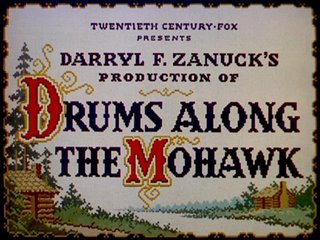
Woah! Technicolor!
This is a little gem of a movie. Directed by John Ford, it stars Henry Fonda and Claudette Colbert, and tells the story of colonists in New York caught up in the events of 1776. For us Europeans with sketchy knowledge of American history, that’s the American War of Independence, where Washington kicked our butts and the Americans made themselves a separate country. Or the Revolution as they call it. Take your pick. I’m not fussy. Fonda & Colbert have their farm trashed by Indians, he goes off to join the militia, and eventually they find themselves under siege in a fort. (Full synopsis on Wikipedia.) It was refreshing to see a story set in this period, as it’s not one that’s covered as often as the Civil War or the Wild West. In recent years, the only movie I can think of that covers this is The Patriot, which is far more political and gritty.
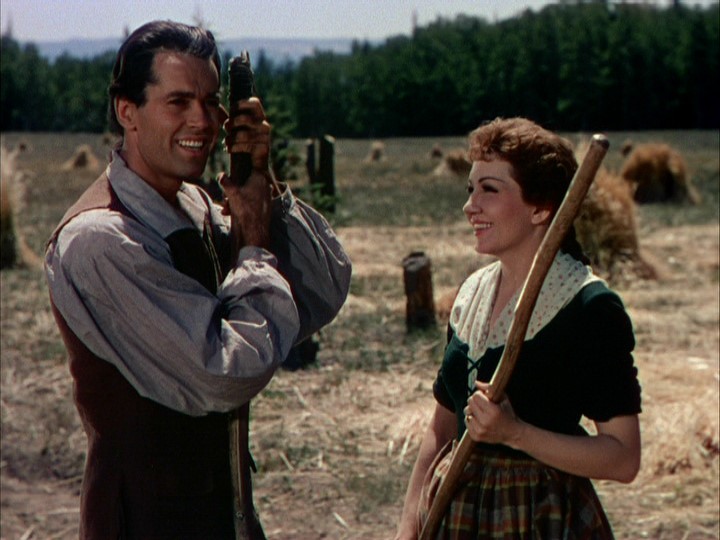
Idyllic rural harmony - but not for long.
What struck me immediately was that it was in colour. The DVD box on the British release makes it look black and white, and the only stills I had seen were black and white, and given the release date of 1939, that’s what I was expecting. The sudden smash of Ford's first ever use of Technicolor was a welcome surprise, and from there on in, Ford’s beautiful eye for a great picture was undeniable. Drums was nominated for an Oscar for its cinematography, and deservedly so. It lost out to Gone With The Wind, which is hardly a surprise, but they’re definitely both in the same league.
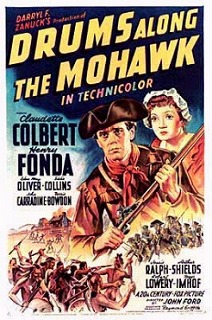
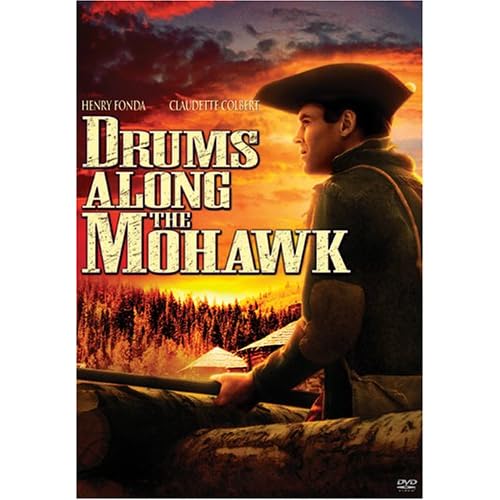
Compare the British and American DVD packaging. Why is the UK one so misleading and dull? Even the stills on the back of the UK box are black and white.
As the film went on, I came to realize that the stand-out performance wasn’t coming from the two leads. While it was fun to watch a young Henry Fonda (who I normally think of in his roles in Once Upon a Time in the West or 12 Angry Men), he was being acted off the screen by the aged Edna May Oliver, appearing in almost her final film. She plays a feisty widow who offers Fonda and Colbert a place to live after they lose their home, and she’s one hell of a character. There’s a great scene where Indians set fire to her house, and she stubbornly stays in her bed, demanding that they carry her – and the bed – out to safety. Magnificent stuff.
She was nominated for an Oscar for Best Supporting Actress, but lost out to (wouldn’t you know it) Hattie McDaniel for her role in Gone With The Wind. (Trivia buffs: Hattie McDaniel was the first black person to be nominated for an Oscar, let alone win one.)


Above, Edna May Oliver. Below, Hattie McDaniel with Vivien Leigh. (And yes, another black and white still from a colour movie.)
Incidentally, Ford did get an Oscar nomination as Director that year, but for Stagecoach, rather than Drums. He lost out to… yeah, you got the idea. 1939 must have been a depressing year for so many people, finding themselves up against That Film.

There's no reason to show this except that I like the poster.
For me, the best sequence of the movie is where Fonda goes off to fight his first battle. He heads off with the militia, leaving his wife waving him goodbye. Then, the next scene is them all coming back from the fight, wounded, tired, and in need of shelter. For a few minutes, I felt cheated. I expected to see a battle sequence, and Ford did it all off-screen. Then we cut to a delirious Fonda, and gradually the story of the battle comes out of him, disjointedly, just as a series of vocal flashbacks and impressions. The result is surprisingly powerful, as your own imagination fills in the horrors of war in a way that you just couldn’t do on-screen in 1939. Not that Ford’s shy of making battle scenes – Drums has plenty of those too.

Intense action as Indians attack. In black and white.
Drums makes for great Saturday afternoon matinee watching. It’s undemanding, entertaining, and carries you along nicely for a couple of hours. It has action, romance, and Ford’s characteristic gentle touch. Thoroughly enjoyable, and undoubtedly one of the very best of Ford’s 144 films. If it hadn’t been for Rhett & Scarlett, this would probably be much better known.
Great turn of phrase
"She had the kind of body I'd only ever dreamed about, in the sort of dream I'd often dreamed of having again."
Nope, not Chandler or Hammett - it's from Berlin Noir, by Philip Kerr.
Nope, not Chandler or Hammett - it's from Berlin Noir, by Philip Kerr.
Tuesday, February 5, 2008
Evil Aliens
You will need beer to watch this movie. Oh yes, you will. And lots of it. Evil Aliens is a gloriously cheesy, low-budget, British sci-fi horror with its tongue very, very firmly in its cheek and gore all over its face. Think Aliens plus Predator plus Shaun of the Dead plus Evil Dead meets The X Files in Wales, and you’re about there. It’s from the twisted mind of Jake West, who made the vampire flick Razor Blade Smile. If you’ve seen any of his films, you’ll know what to expect; inyaface outrageous action, dark humour, and women with not enough clothing. In this case, West gives us the lovely Emily “Bouff” Booth, who British viewers may recognize as the presenter of various late-night TV shows such as outThere. Babe with a shotgun and a welsh psychopath in tow. You should have got the idea by now what you're in for.

This is as close as you get to seeing boobies.
The plot is really simple. A Welsh woman claims she’s been abducted and impregnated by aliens, and the presenters of a failing TV show go to investigate. And guess what, there really are aliens, and they’re, um, evil. When they find themselves trapped by the tide, the killings and the multilations begin. If you’re squeamish, don’t watch this movie. Really, don't. You may not get past the opening sequence where the aliens carry out a rectal examination on the woman’s boyfriend. And don’t let your kids watch it either.

Everyone gets completely blood-splattered. It's that kind of movie.
The highlight of the movie was a wonderful scene featuring a combine harvester which wins a Mongoose Award for Most Inspired Use Of Wurzels Music In A Movie. (For my transatlantic readers, The Wurzels are the English equivalent of hillbilly music. Everyone in England knows the words to their songs, but nobody will admit to it.) It’s sheer cinematic genius, right up there with I Will Survive in Priscilla, Queen of the Desert. It had us all drunkenly humming Combine Harvester several hours later, still unable to stop laughing. I’m not saying any more. Watch it for yourselves.

So come on now, let's get together in perfect harmony...
The character acting is magnificently hammy, especially the three Welsh farmers – who don’t speak a word of English. They start off as really unlikeable, grotesque characters, but after a while – ok, ok, once they get going with the chainsaws and shotguns – you really find yourself rooting for them. The “UFO expert”, Gavin Gorman, is another great character, the quintessential UFO nerd, very much like the Lone Gunmen in the X Files. You’re never quite sure whether to laugh at him, hit him, or root for him. And the aliens themselves? Brilliant. For men with silly masks and silver suits, they’re really rather entertaining. They’re unbelievably stupid cannon fodder, and really evil at the same time, just like good Doctor Who baddies should be. And yes, that is Norman “Holly” Lovett in a bit part at the start.

Aliens with satanic symbols on their masks. Huh?
The special effects are much better than you’d expect for a low-budget movie. The alien spaceship is quite impressive really, and while it’s no Independence Day, it’s a long way from crappy models on fishing wire. And the prosthetics are great - limbs and heads get ripped off with gleeful abandon, people get impaled on all sorts of objects, and the surgical scenes are really ghoulishly visceral.

Actually rather effective for a cheap lighting trick.
I thoroughly enjoyed Evil Aliens. If you’re not British, you may not get it, but that’s OK. I can imagine several people I know who would love to make a living out of making movies like this; cheap, cheerful, entertaining. Sometimes "quality" is overrated, and all you need is an irrepressible sense of fun. Evil Aliens is never going to win critical acclaim, but it’s earned a place in my DVD collection.
Babe with a shotgun and a welsh psychopath in tow. You should have got the idea by now what you're in for.Saturday, February 2, 2008
Do credits on TV matter?
So the BBC is being forced to rethink the way it scrunches the credits into a corner. Which is great news for actors and crew who like to see their name on a show they've worked on. And great news for people who actually care who did the music or the dubbing or who the executive producer was. But how many ordinary viewers actually give a monkey's? Do you watch the credits? Do you care if they're squished - or even cut? Or do you think they should be shown out of respect for the creators?

Put some colour into it! (Or don't.)
Thoughts inspired by watching Good Night And Good Luck
 This still looks fine, but they can't carry it through the rest of the movie.
 A single, unforgettable touch of colour.
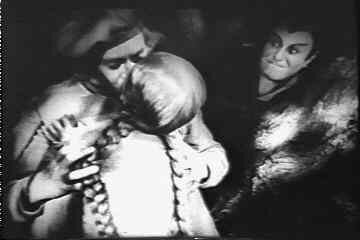 Murnau's Faust. Wonderful composition. The nearest you get to this in colour is Herzog's Nosferatu
 One of the very few Welles films I like, worth watching just for the grotesque characters
This still looks fine, but they can't carry it through the rest of the movie.
I have no objection to black and white films. In fact, I'd guess that about a third of my movie collection is in black and white. But I do sometimes wonder why people make movies in black and white these days. It's not like the Forties and Fifties where black and white was a cheap option. More often than not, it comes across as pretentious rather than stylistic.
Spielberg got away with it in Schindler's List, but only because of that one famous image of the girl in the red dress. Putting everything else into monochrome made that single shot into an unforgettable (and much copied) piece of movie legend.
A single, unforgettable touch of colour.
But a movie like Good Night And Good Luck, the biopic of anti-McCarthyite crusader Vic Morrow, had no need to go monochrome. Obviously it was done to create the period feel, and to keep the archive footage homogenous, but this didn't really work. Instead, it just made the film look drab and cheap rather than historical. It looks as if it was shot using standard modern kit, and post-processed to have the colour removed. The result doesn't look like 1950's film stock, it looks like a modern digital effect, and that, for me, ruined it.
There were a number of other reasons I didn't like GN&GL (such as the slow story, confusing sound mix, and unengaging characters), but the decision to go black and white offended my cinematographic sensibilities. If you're going to make a colourless film these days, you need to replace colour with some other visual element. This means an excellent grasp of composition and lighting. You can't just shoot as normal and then take the colour out. It doesn't work that way. It's like colorising black and white movies - wrong, wrong, wrong!

Paul Wegener's unique visual style in Der Golem (1915)
When you work without colour, you need to be thinking of every shot in terms of shape. Ignore what you see through the lens - you have to understand what the image will look like when bereft of colour and reduced to light and shadow.
Murnau's Faust. Wonderful composition. The nearest you get to this in colour is Herzog's Nosferatu
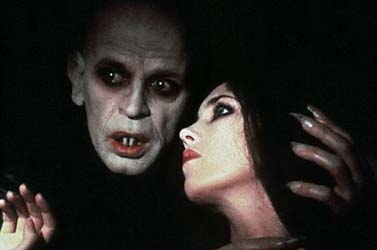
Herzog uses heavy black backgrounds to emulate Murnau
The German Expressionists - Murnau and so on - were the real masters of this style, taking it to extremes. Sean Branney's excellent Call of Cthulhu, a homage to the silent horror movie, is one of the few recent films that makes this work. Or look at Jim Jarmusch's poetically beautiful Dead Man, where every shot is a memorable still photograph. And don't forget the hugely stylish Sin City, which transplants the unique look of Frank Miller's comic book to the screen, and really pushes for black and white, not greyscale.
 As striking as Jack Sparrow, for my money
One key issue when filming black and white is that the differentiation between foreground and background has to be rethought. A red costume against a blue background may look fine, but if the tone is too similar, you get grey on grey and the character gets lost. To bring that differentiation back, you can use focus to blur the background out, but that's a real problem with some modern film kit, and especially with digital animation like machinima. You can also accentuate the difference with lighting, but that's also a problem for machinima which generally has very little lighting control.

The sort of lighting effect you only really get from black and white
For the machinimator or digital animator, the answer is to direct in black and white from the get-go. Don't take colour footage and post-process it, lose the colour right away. That's a luxury real film-makers don't always have.
I may try making some black and white machinima - one of the scripts I'm working on is inspired by Orson Welles' Mr Arkadin (aka Confidential Report), and I reckon that's the feel it needs. Now I need to persuade the Moviestorm dev team to make a black & white shader to go with the cel shader they've already done!One of the very few Welles films I like, worth watching just for the grotesque charactersFriday, February 1, 2008
Loaded for bear
A new gastronomic experience awaits. We have a friend coming over from Finland in a few weeks, and he's bringing not just some reindeer (which I've had once before), but moose (which I haven't but I'm guessing is similar), and bear (which I've never had, but he assures me is "pretty strong stuff"!).
Taste buds are tingling already...
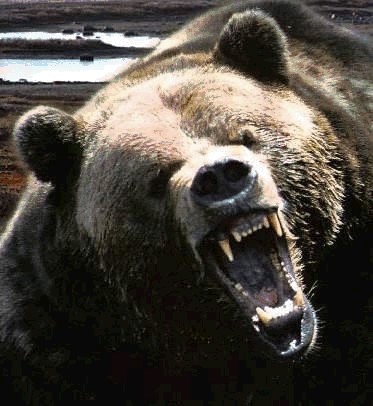 Get on my plate!
Taste buds are tingling already...
Get on my plate!
Subscribe to:
Posts (Atom)