Saturday, February 2, 2008

Put some colour into it! (Or don't.)

Thoughts inspired by watching Good Night And Good Luck

This still looks fine, but they can't carry it through the rest of the movie.

I have no objection to black and white films. In fact, I'd guess that about a third of my movie collection is in black and white. But I do sometimes wonder why people make movies in black and white these days. It's not like the Forties and Fifties where black and white was a cheap option. More often than not, it comes across as pretentious rather than stylistic.

Spielberg got away with it in Schindler's List, but only because of that one famous image of the girl in the red dress. Putting everything else into monochrome made that single shot into an unforgettable (and much copied) piece of movie legend.

A single, unforgettable touch of colour.

But a movie like Good Night And Good Luck, the biopic of anti-McCarthyite crusader Vic Morrow, had no need to go monochrome. Obviously it was done to create the period feel, and to keep the archive footage homogenous, but this didn't really work. Instead, it just made the film look drab and cheap rather than historical. It looks as if it was shot using standard modern kit, and post-processed to have the colour removed. The result doesn't look like 1950's film stock, it looks like a modern digital effect, and that, for me, ruined it.

There were a number of other reasons I didn't like GN&GL (such as the slow story, confusing sound mix, and unengaging characters), but the decision to go black and white offended my cinematographic sensibilities. If you're going to make a colourless film these days, you need to replace colour with some other visual element. This means an excellent grasp of composition and lighting. You can't just shoot as normal and then take the colour out. It doesn't work that way. It's like colorising black and white movies - wrong, wrong, wrong!

Paul Wegener's unique visual style in Der Golem (1915)

When you work without colour, you need to be thinking of every shot in terms of shape. Ignore what you see through the lens - you have to understand what the image will look like when bereft of colour and reduced to light and shadow.
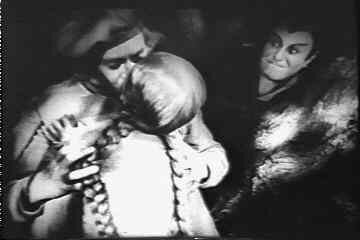
Murnau's Faust. Wonderful composition. The nearest you get to this in colour is Herzog's Nosferatu
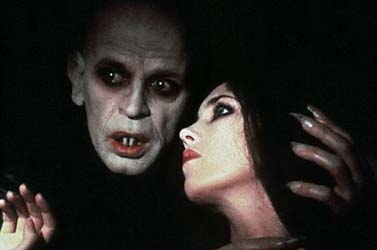
Herzog uses heavy black backgrounds to emulate Murnau

The German Expressionists - Murnau and so on - were the real masters of this style, taking it to extremes. Sean Branney's excellent Call of Cthulhu, a homage to the silent horror movie, is one of the few recent films that makes this work. Or look at Jim Jarmusch's poetically beautiful Dead Man, where every shot is a memorable still photograph. And don't forget the hugely stylish Sin City, which transplants the unique look of Frank Miller's comic book to the screen, and really pushes for black and white, not greyscale.

As striking as Jack Sparrow, for my money

One key issue when filming black and white is that the differentiation between foreground and background has to be rethought. A red costume against a blue background may look fine, but if the tone is too similar, you get grey on grey and the character gets lost. To bring that differentiation back, you can use focus to blur the background out, but that's a real problem with some modern film kit, and especially with digital animation like machinima. You can also accentuate the difference with lighting, but that's also a problem for machinima which generally has very little lighting control.

The sort of lighting effect you only really get from black and white

For the machinimator or digital animator, the answer is to direct in black and white from the get-go. Don't take colour footage and post-process it, lose the colour right away. That's a luxury real film-makers don't always have.

I may try making some black and white machinima - one of the scripts I'm working on is inspired by Orson Welles' Mr Arkadin (aka Confidential Report), and I reckon that's the feel it needs. Now I need to persuade the Moviestorm dev team to make a black & white shader to go with the cel shader they've already done!

One of the very few Welles films I like, worth watching just for the grotesque characters

Friday, February 1, 2008

Loaded for bear

A new gastronomic experience awaits. We have a friend coming over from Finland in a few weeks, and he's bringing not just some reindeer (which I've had once before), but moose (which I haven't but I'm guessing is similar), and bear (which I've never had, but he assures me is "pretty strong stuff"!).

Taste buds are tingling already...

Get on my plate!

Tuesday, January 29, 2008

"I changed my life today, what did you do?"

The Verdict

A legal thriller that isn't based on a John Grisham novel - something of a rarity these days!

Sidney Lumet cut his directorial teeth on the tense courtroom thriller Twelve Angry Men in '57, before going on to gritty action flicks like Serpico in ‘73 and Dog Day Afternoon in ‘75. He returned to the legal genre in ‘82 with this highly acclaimed tale of medical incompetence and the fight for justice.

The Oscar-nominated script by David Mamet centres on the question of whether the parents of a girl who died in hospital should settle out of court without making a fuss, or whether to take the case to trial and force the doctors to admit that they were negligent. The drama, of course, is that the judicial system is so heavily on the side of the medical establishment (and, in this case, the Church who runs the hospital) that it doesn’t look as though there will be a fair trial. Should they cave in and take the money, or stand up for justice?

Paul Newman, pushing sixty when he made this, delivers a powerful performance as Frank Galvin, the cynical, hard-drinking, world-weary lawyer who finds he has a real case for the first time in years. (The quote at the start is, of course, from him.) A cliche of a character, sure, but well done. Think of Tom Cruise in The Firm crossed with Sam Spade and you’re about there. Newman lost out on the Best Actor Oscar to Ben Kingsley in Gandhi, which is, admittedly, hard to argue with.

James Mason plays the opposing lawyer, which he does in his usual suave manner. I like Mason, I like him a lot, but on this occasion he doesn't seem to quite come up with the goods. His performance is polished enough, but he portrays the character in such a fair and reasonable light that the result is bland rather than dramatically ruthless. A little more melodrama wouldn't have gone amiss. Mason got an Oscar nom as well, though it’s hard to understand why, until you look at the competition that year. For me, the real villain of the piece is Milo O'Shea as the judge who's obviously biased in favour of the defence.

Charlotte Rampling is at her most icily gorgeous as Laura Fischer, Newman's supportive lover who's playing both sides. (This was the last film she made before getting hitched to Jean-Michel Jarre.) Oddly, though, I kept on wanting Sigourney Weaver in the role; Rampling comes across as a bit of a scheming, unfeeling bitch, rather than the tough, powerful woman Weaver would have been. I wasn't really interested in the sub-plot with her, though. It was never really as developed as it might have been, and I couldn't really work up any interest in her character.

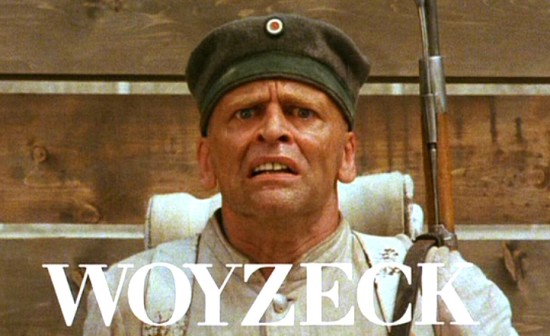
Where The Verdict really wins for me is the very elegant style. The camerawork is well worth a close look. It's not flashy or complex, but it's a very good example of how to use simple shots very effectively and economically. Some scenes are shot entirely with a single static camera in long shot, which works surprisingly well. Normally this technique only turns up in very early films or in arty movies like Werner Herzog's unremittingly bleak Woyzeck, but Lumet makes it work. The simplicity of the camerawork, combined with almost total absence of music, gives the film a very real feel that is quite different from the cinema verite style the directors of the Seventies were trying to ape.

The very few 'tricksy' shots are nicely constructed; there's one sequence where we look through a window at Newman and Jack Warden coming down the stairs inside the courthouse, and then the camera pans gently to pick them up as they come out through the door. This is very distinct from the more 'in your face' style of filming that Lumet picked up from movies like The French Connection, and it makes for easy viewing, allowing you to concentrate 100% on the story. Aspiring cameramen, editors and directors would do well to see how much you can achieve without ever drawing attention to the camerawork, moving the camera only when necessary, and cutting smoothly and efficiently to keep the viewer engaged.

Gene Hackman in The French Connection

On the whole, I preferred this to Lumet's earlier action films, and I'd undoubtedly rate it as one of Newman's best roles. In my view The Verdict isn't a great film, despite also getting Oscar noms for Best Picture and Best Director (did you count ‘em? That’s five noms, no wins, thanks to Gandhi) but it's very definitely a good, solid, well-made drama with an easy-going style that's well worth a couple of hours.

Wednesday, January 23, 2008

Silkwood, or how to make plutonium mundane

It’s odd to realize that this movie is now 25 years old. Even though it fits right into one of my sweet spots (loner takes on the evil bastard Corporation), I’ve managed to avoid watching it all this time, largely because I don’t like Meryl Streep. (Who, according to IMDB, is "considered by many movie reviewers to be the greatest living film actress". Bollocks. Lauren Bacall is still alive. And still acting.)

Even the DVD cover looks dated.

I decided to give it a go, after realizing that a lot of the actors and films I “don’t like” are actually rather good. Unsurprisingly, my opinions and tastes of 20 years ago aren’t the same as my opinions and tastes now. Humphrey Bogart is a case in point. I don’t like Bogart, except for Treasure of the Sierra Madre, and The African Queen, which are two of my all-time favourite movies. And The Caine Mutiny, which is tense, well-acted, and gripping. And several of his film noir classics; Key Largo, Dark Passage, and The Big Sleep, which is just brilliant (and better than The Maltese Falcon, even though Peter Lorre isn’t in it). And High Sierra, which is a tight nailbiter of a film. And Sahara is a perfectly enjoyable war movie. Now how can I say I don’t like Bogey? What I really mean, I think, is that Casablanca is over-rated. But maybe I should give it another look soon and see if maybe it’s not that bad. Watch it again, Sam.

Bogey. Portrait by E. Smyth. That's not bad going - getting Bogey and Bacall into a review of Silkwood, and we're only two paragraphs in....

Yeah, Silkwood. Where was I? I hadn’t realized Cher was in it at all, let alone the fact that she was nominated for Oscars and BAFTAs and stuff, and actually won a Golden Globe for her performance. I thought her first major film role was Mask, which was a gobsmacking movie. I was going through my biker phase at the time, so any movie about bikers was pretty well guaranteed to get my attention, and I really liked the portrayal of bikers as human beings, not just stereotypical bad guys. I didn’t think she was that good in this, though. She was OK, but I wouldn’t have marked this as one of the great performances of 1983. Not that 1983 was a vintage year, or anything, but this really wasn’t anything to get excited about.

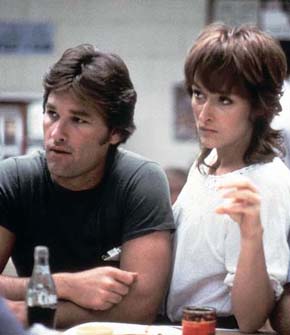
Kurt Russell plays Kurt Russell, as always

I’m finding it really hard to stick to the subject here, just like I found it hard to stick to the movie. I kept on going out and making coffee or finding a biscuit, or suddenly remembering that I had to make a phone call. Frankly, the movie just didn’t grab me. It was slow, and I wanted it to be far more like The Insider. Now that was a punchy movie. Silkwood just left me feeling like I didn’t really care. We’re talking true stories about plutonium here, folks, and I’m not caring that big companies are screwing around with it? That can’t be right. The whole sub-plot about Karen’s relationship with her boyfriend was tedious, and the film was far more focused on her attempts to organize a union than on the fact that the safety procedures were slipshod and frequently bypassed. Let’s face it, Karen Silkwood wasn’t exactly Jimmy Hoffa or Arthur Scargill when it comes to exciting, larger than life personalities in the union world. (Ah, bring on The Comic Strip presents… The Strike! That was a lot of fun.)

And the end was just limp. She died, and nobody knows exactly why. Not the writers, and not the viewer. That could have made a great start to the movie, though. Throw in some mystery, some confusion, a bit of conspiracy, and then take us on a journey to show how we got here. Then everything would have dark, ambiguous overtones, and it would have been a very different movie.

A high-tech nuclear facility run by the lowest bidder - should be much more scary than it is

I reckon it was a successful film only because it dared to tackle the subject it did, and not because it’s actually a good film. Meryl Streep was actually pretty good, though. But not good enough to make me re-watch Kramer vs Kramer or Out of Africa.

Tuesday, January 22, 2008

Animusic - music video extreme

One of the unexpected things I got for Christmas was a pair of DVDs from Animusic. These are, no question, the most amazing music videos since Peter Gabriel did Sledgehammer back in 1986. (Which was an early work from Aardman Animations, of Wallace and Gromit fame, collaborating with the Brothers Quay, apparently. I never knew that. Wonderful thing, the Internet. But already I digress, after a mere two sentences.)


Resonant Chamber: a truly baroque instrument, which sounds as wonderful as it looks
What the Animusic guys do is to create unbelievable virtual instruments. No, that’s not quite true. The instruments they create are all too believable. They’re so detailed, and they play so right, that you actually start believing in them and forget that what you’re watching is just CG. They’ve been doing this for about fifteen years, so the earliest of their videos are older than the first Toy Story movie. As you might expect, some of them look a little dated now – but only a little. Fair enough, the mid 1990s lighting effects are a little simplistic, and the shadows and reflections aren’t quite as perfect, but that’s about it. After all this time, they’re still jaw-droppingly good. And by the time you get to what they've been doing in the last few years - well, it's easily comparable to anything you'll see from Dreamworks or Pixar.
Whatever Jimmy Page can do, we can do better!
But these videos aren’t just impressive for their computer animation skills. To the musician, they’re quite simply mesmerizing. Animusic use MIDI to drive the animations, so every note is perfectly played – strings vibrate harmonically, cymbals wobble and tremble, and so on. It’s just like watching a real instrument. If you thought the piano animation in The Corpse Bride was good, you ain’t seen nothing. After spending much of the last few months working on the music video packs for Moviestorm, I really, really respect what they’ve done here. They use a proprietary bit of software called ANIMUSIC|studio that enables them to do stuff that nobody else can even come close to. This isn't just your standard music animation. This is artistry and sheer genius of the absolute highest order. This sets the standard that the rest of us should aspire to.
It's like having a musical fish tank - utterly relaxing
The music’s damn good too. It mostly has an 80s prog rock feel to it, very Alan Parsons, ELP, or Yes-ish, and you often get the feel that what they’re trying to do is out-Jarre Jean-Michel – and succeeding! These are the stage shows he’d have liked to have done, if only it were physically possible and he’d had the money. I’d love to see some of these videos on a huge IMAX screen – now that would be quite something. They have a fairly wide musical range: some of the pieces are pure percussion, others are acoustic strings, with styles ranging from jazzy to techno. There’s stuff on there which appeals to everyone from my retired mum to my teenage kids (one Goth, one metalhead) and even my youngest daughter, whose taste mostly runs to Andrew Lloyd Webber and novelty singles in the charts. That alone takes some doing!
Like Jarre in Docklands, but turned up to 11!
I’d be hard pressed to pick a favourite from the 15 tracks on the 2 DVDs, but for me, three in particular stand out. (Click for YouTube links.) Resonant Chamber features a stunning multi-stringed guitar thing. This was the first Animusic piece I found, and it made me go and hunt out the rest. Aqua Harp is another beautifully relaxing piece, most notable for the picks which swim lazily around like fish. And Pipe Dream is an Internet classic, featuring bouncing balls and a percussion kit that has to be seen to be believed. (There I go with the believability thing again!) Not only are these so beautifully executed it leaves me open-mouthed with the hairs standing up on the back of my neck, but the wonderfully warped creative vision that goes into each piece is like nothing else I’ve ever seen.
A truly steampunk percussion device
I spent much of 2006 and 2007 evangelising about the HPLHS Call of Cthulhu movie. Now that I’ve told as many people as I can about that (and persuaded several of them to buy it), I’m going to start babbling on about Animusic. I promise not to do this very often, but here comes the plug. Go to their site and buy their DVDs. No, really, do. Whether you’re a musician or an animator, it’s a very, very fine way to spend 35 bucks.

Monday, January 21, 2008

A famous Kelland!

"Kelland was one of the most widely read and highest paid authors in the world."

Sadly, they’re not talking about me. They’re talking about a guy called Clarence Budington Kelland (“Bud”), who was a hack writer of the early 20th century. Bud wrote literally hundreds of magazine stories and sixty-odd novels. Several were made into movies – most notably, his story Opera Hat was the basis for the classic 1936 Gary Cooper / Frank Capra movie Mr Deeds Goes To Town (and the 2002 remake Mr Deeds with Adam Sandler and Winona Ryder).


Although Bud was financially very successful, he never achieved lasting fame. He wrote, "When I am very old, people will begin to believe I was a greater man than I was, and that will tickle my vanity. There will even be people who will feel it a little distinction to be around with me, because a sort of tradition will have built itself around me, and legends and so on. None of which, probably, will be true, but they will be there and I shall benefit from them." Harlan Ellison used Bud as an example of “how easily a once famous writer could be forgotten".

According to The Wicked and the Banned, a 1963 book about the history of censorship in America, the stories Bud was writing in 1919 caused a furore and prompted a review of what was deemed acceptable in print, though I can’t find anything about this in the online sources. Now there’s a man I can relate to. Churn out the work, be happy to describe yourself as “the best second-rate writer in America”, get paid shedloads, and upset people.

Bud died aged 82, almost exactly when I was born. It’s an odds-on cert that he was a none-too-distant relative. There aren’t a lot of Kellands in the world, so we’re pretty well all related one way or another. I reckon I can even place him in the family tree, in the blank bit that says “went to America mid-19th century” about four generations back. He looks a bit like my Dad too. Next time I’m in the States, I might see if I can swing by Portland, Michigan, and go see the Kelland Memorial.

What makes a good story?

Heard on a podcast by Mike Jones about using CeltX.

"Drama is when somebody wants something and somebody else gets in their way."

Succinct, and dead on target.