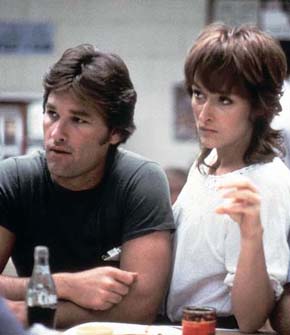
I have to admit, I quite like voice-overs. I prefer Blade Runner with the voice-over, for example. Anyway, this got me thinking about voice-overs in general, and in particular why I’d want to use it in machinima.
The earliest use of voice-overs was mainly for narration and scene setting. Instead of audiences having to read text telling them what was going on, a narrator simply told them what was happening. This was all part of opening up movies to illiterate audiences, and made the whole movie experience less wordy. A great example, if only for its stiff upper lip British pomposity, is William Cameron Menzies’ Things To Come, where the narrator explains to the audience at each stage how the world got the way it did, at times interjecting with authorial moralization. When you look at that film now, the voice-over seems really clumsy, but the device has stayed in use in all sorts of formats.

Things to Come, based on the HG Wells novel
Think of the opening to Fellowship of the Ring, where we get a full introduction to Middle Earth through the narration of an epic battle. Or SF shows like Babylon Five (“the last, best hope for mankind”), Dune (“the spice must flow”), or even, though I hate to mention it, Star Trek (fill in your own quote, depending on which series you prefer). Voice-overs work particularly well for SF and fantasy, as there is usually a lot to explain to the audience, not very long to do it in, and relying on the script to carry all that back-story is hard to pull off.

Aah, an excuse to show a picture of Claudia Christian
In shows like Dragnet and Kolchak (a cheesy 70s precursor to The X Files), for example, the voice-over sets not only the scene but the tone of the show by mimicking police files. You know the style: “11:43 pm, July 25th, Los Angeles. Jenny Jacks is walking home, alone, unaware that she has been singled out by a serial killer. 11:52 pm, Officer Gerry Osgood arrives on the scene.” It’s really easy to parody that stuff, but writers continue to use it time and time again. It’s a really neat short-hand, almost like having Scully reading from her report – off-screen – at the end of each X File.
Sometimes the voice-over is used to supplement what’s on the screen, reading the exact same words for those who can’t be bothered to read them for themselves. In Dark Prince: The True Story of Dracula, there is a long opening explanation and historical introduction which, quite frankly, goes on far too long. If I’d had to read it all, I’d have been asleep before the movie actually started, which would be a shame, because it’s actually quite interesting and not your usual bloodsucker movie. Voicing it helped. And having the text as well meant that I didn’t lose track of what was going on due to being distracted by the visuals, unlike, say, Underworld Evolution, which still hasn’t made sense to me yet.

Dark Prince, a bio pic of Vlad Dracula. It's actually not bad
However, the main use of the voice-over, and what we mostly think of when we think of a voice-over, is to provide the first-person internal monologue that movies can’t provide any other way. It’s a staple of the film noir, which we always associate with Bogart and the like. The essence of Chandler and Hammett’s writing was to portray not just the story, but what it felt like to be a down-at-heel gumshoe. The books are full of commentary, effectively talking straight to the reader, and that’s not something you can do easily in movies. Ian Richardson did an amazing job of talking straight to camera in House of Cards, but that was the exception, rather than the rule.

Francis Urquhart: shows what a Shakespearean training can give you in the art of the aside
In general, you need to get the scriptwriter to put in a second character and put in the commentary in dialogue – hence the reason why so many movie adaptations give the hero a sidekick who wasn’t in the books. David Suchet’s Poirot, for example, uses Hugh Fraser as Captain Hastings and Philip Jackson as Inspector Japp far more than Agatha Christie ever did, purely to give Poirot someone to be in the reader’s place and allow him to explain himself without breaking the frame of the movie.
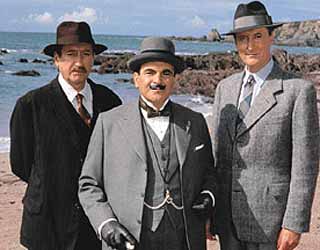
Not one but two dumb sidekicks
The only other option is the voice-over, which seems to be less and less popular these days. The voice-over really does shatter the illusion that you are watching reality. As the viewer, we are seeing this character do the things he does, but at the same time he’s talking to us, reminding us that what we’re watching is a story, an artificial construct.
Probably the best example of this is Kiss Kiss Bang Bang, a superb vehicle for Robert Downey Jr and Val Kilmer. Robert Downey’s totally irreverent narration turns this from a humdrum thriller into a wonderful cinematic experience. Director Shane Black plays with the conventions of filmic story-telling; fairly early on, he gets us into a flashback sequence by having Harry Lockhart go “woah, back up, there’s something I should have told you” (or words to that effect) and then apologizing for telling the story all wrong. It works really well – most of the time. Sadly, towards the end it gets more conventional, and not as much fun.

Kiss Kiss Bang Bang. Probably my favourite Robert Downey Jr movie.
I guess that’s the real kicker with voice-overs. Do them well, and they can work really well. But if you’re not careful, they can be lame, and a substitute for second-rate acting and directing. For example, I could have two characters have a conversation, and as one leaves, the other says in voice-over, “I knew I had to keep my eye on her. She was lying. I didn’t know what about, but I knew she was lying about something.” Very Phillip Marlowe. But instead, you could cut to a well-lit and well-framed CU, and convey all that with just a twitch of the eyebrow and a slight sneer.
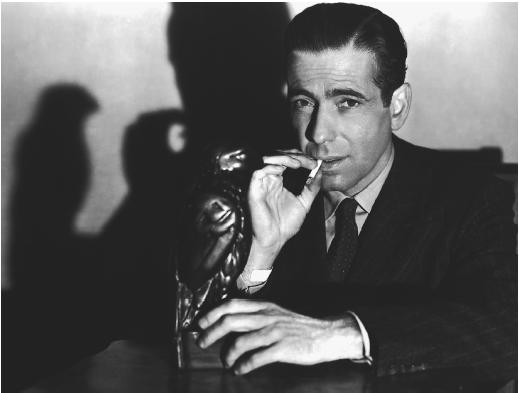
Well, we had to have one picture of Bogey in this article, didn't we?
In machinima, though, you’ve got an excuse for going the voice-over route. Most of the time, you just don’t have the subtlety of performance you can get from a real actor or a hand-animated virtual actor. A "twitch of the eyebrow and slight sneer" in machinima can easily end up as a Groucho Marx eyebrow wiggle with a demented Joker-like rictus, which ain’t exactly the effect we’re after.
So where I find myself heading is that, if I were filming with real actors, I’d probably rely on them to carry the unspoken sub-text. But because I’m using machinima – and also consciously trying to get a bit of 1950s style into it – I’m going to give the voice-over a go. And if it turns out wrong, then hey, it’s machinima, I can afford to start again.