Monday, October 18, 2010

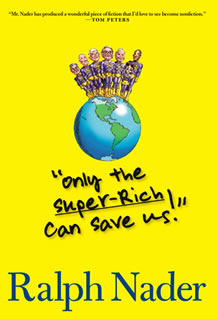
Only the super-rich can save us!

The world's pretty messed up right now. Everything's controlled by a few huge corporation who are to all intents and purposes above the law. Governments answer to the interests of big business. And big business answers to the interests of a few billionaires. The rest of us really don't matter a damn, and neither does the planet. Everything is sacrificed in the interests of profit.

So what can we do about it? Realistically, probably not a damn thing. We can elect different politicians, and within months, they'll be completely in thrall to the same old corporations. We can launch consumer protests and boycotts, but they have such a hold on every aspect of our way of life that it'll only work if we all go back to being self-sufficient pioneers, and that just ain't gonna happen.

In this book, Ralph Nader plays with an interesting idea. What if a bunch of super-rich people got together and decided to change things? Using the skills they've learned for manipulating governments, media, and economies, and their vast personal fortunes, they effectively launch a commercial revolution. They champion alternative energies, they challenge Wal-Mart's stranglehold over retail, they tackle healthcare billing fraud and insurance companies, and they fight the way that corporations buy politicians. As a Brit, I missed some of the political and commercial references, but enough came through to keep me hooked throughout. I also learned a lot from his use of real legal cases and legislation.

Nader's protagonists are all real billionaires or multi-millionaires; Warren Buffett, George Soros, Ross Perot, Ted Turner, Bill Cosby, Bill Gates Sr, Paul Newman, and Yoko Ono, for example. By contrast, most of their "opponents" are fictional: CEO Cumbersome, Edward Edifice, and so on. This gives the book a strange feeling. It keeps reminding you that Nader's talking about the real world, not some imaginary thriller conspiracy world, but at the same time, it's only fiction.

Now obviously, this is a satirical fantasy, and it's wildly utopian. Somehow, I don't think these guys are going to pledge their personal fortunes to save the world. However, it's an enjoyable book, and an easy read even though it's nearly 800 pages long. Nader's analysis of what's wrong with American society is insightful, and needs to be read.

For me, the best part was when he showed how overturning the corporations was not just within the spirit of the Constitution, but was also completely compatible with capitalism. Nader argues that what we have in the US isn't actually capitalism, it's state capitalism. The big corporations are backed by the state and supported by the state. The laws are written for their benefit. They pay lower taxes than smaller businesses or individual. They get huge handouts. They control the courts and the media. They get preferential treatment in every way. That's not free market competition. That's not capitalism. That's basically an economy based on state-sponsored monopolies - a classic hallmark of communist regimes.

Although I don't get to vote in this country*, I'm trying to get to grips with American politics. I'm rapidly coming to the conclusion that the whole Republican/Democrat thing doesn't matter. They may chant different slogans, but in the end, they don't run the country. The corporations do. Whoever gets to Washington, it's the corporate lobbyists and their vast budgets who decide how Congress votes. They're happy as things are and can effectively block any changes that don't benefit them. And you don't get to vote for them. Worse, they have huge support because of their total control over big media. "What's good for business is good for America," they say. "If you damage our business, it'll cost jobs," they threaten. "We bring you cheap goods - what's the problem?" they ask. And so people nod and turn a blind eye to all the corruption, profiteering, and monopolistic abuse of power.

If you want to see real change in America, what's needed is to get rid of the unelected cartel that controls the government, and Nader makes this point eloquently, passionately, and with conviction.

"I hope we shall crush in its birth the aristocracy of our monied corporations which dare already to challenge our government to a trial by strength, and bid defiance to the laws of our country."
Thomas Jefferson

*I can't vote because I'm a resident alien, not a US citizen. I could opt to become a US citizen in a couple of years, but I haven't decided whether that's something I want to do.

Sunday, October 17, 2010

Rework

Are you an entrepreneur? Managing a small software company? Thinking about getting into a start-up? Frustrated by the way your work/life balance is shot to hell?

Then get a copy of Rework, put it in your bathroom, and read a few pages every time you have a few moments. It's full of short, insightful essays, typically a page long, that add up to a different vision of how you can do business, and what a successful company can look like.

Some of it's pretty obvious advice. Meetings are toxic. Don't hire too many people too early. Love what you're doing or it'll show.

Some of it's slightly utopian, and only suitable for certain sorts of companies. Hire people who don't need managers and will just get on with whatever needs doing. It's OK for everyone to work from home, scattered round the world as long as they communicate online every day. Make sure you can do every job in the company yourself. Keep your product really simple.

Well, that's all fine if you're building a small software product, and you only need a few talented programmers to create it and refine it step by step. That doesn't always work so well if you're building a complex product that requires a lot of people working together. Or, come to that, opening a restaurant. Sometimes, you need a roomful of grunts and a manager just to get through the sheer volume of labour and ensure everyone's working effectively. And if they're highly specialised grunts, you can't really expect anyone else to be able to do their job. That, after all, is why you hired them.

However, there are some pieces in Rework that challenge orthodox business thinking, particularly in the modern tech start-up. These are the bits you need to read and think about. The five that stuck in my mind this time were:

Planning is guessing. No plan I have ever made for a business has come to reality. And, probably, neither have any of yours. All those optimistic budget forecasts, sales forecasts, hiring plans, release schedules, marketing plans - all bollocks. They looked impressive, and people signed up to them, but the truth is they were my best guess, nothing more, and they all turned out to be wrong. Hell, I can rarely even plan for what I'm going to do next week. Things change too fast in modern business. So, they advise, stop wasting your time making pointless plans, set some goals, and just do the damn job. Or, if you do have to make a plan, make sure you and everyone else knows they're only a guess.

Don't write down the procedures. Forget sheets of diagrams and documents explaining you do everything in the company. You won't stick to them anyway. A release checklist or similar, fine. But don't waste your time writing down stuff that either everyone knows, or which will be ignored in the heat of the moment.

Don't plan for an exit. This one's anathema to investors. After all, you only build a company so you can sell it, right? Well, that's one view of business. Alternatively, you could build a company that you can stick with for ever, and do it because you love it.

No to-do lists. Actually, I don't agree with this one. I'm a to-do list person. But I do like their suggestion not to waste time going through and prioritising everything 1, 2 or 3, and giving everything a target date, importance, and so on. Instead, just pick the most important thing, put it at the top of the list, and do that. Then, when you've gone as far as you can with that, pick the next most important thing, and do that.

Don't be a hero. If you're the guy working until 11pm every night, you're not doing anyone any favours. You're going to be tired and unproductive, and guilt-tripping your colleagues into working longer hours isn't going to endear you to anyone. More to the point, if what you're working on is really taking that much effort, then you should seriously consider whether you're going about it the right way.

The main themes of Rework are that in most companies we waste too much time on unnecessary management, and we'd all get a lot more done if we just got on with what was most important to delivering a great product to our customers. As I said, not all of this applies to everyone, but it should certainly get you thinking about how you and your company could work more efficiently, get more done, and spend less time doing it.

Monday, October 11, 2010

National Coming Out Day

Today's National Coming Out Day. I hadn't heard of this until I noticed many of my friends posting about it in their FB statuses. I was going to just cut'n'paste their standard phrases into my status, but figured I needed more than a couple of sentences.

First off, I really don't give a damn about other people's sexual orientation. Straight, gay, bi, bi-curious, celibate, transgender - it makes no difference to me whatsoever. I care about the people I like because of their personalities, and I'm more interested in talking to them and enjoying their company than what sort of genitalia they like their sexual partners to have.

Second, I don't see why same-sex couples shouldn't be allowed to marry. It's surely better than being trapped in a fake marriage and having affairs to satisfy your sexual inclination. At one point, shortly after it was legalised in England, I think I knew more gay married couples than straight married couples. They seem to be perfectly happy, and as much in love with each other as any straight couple. If anything, more so, because they have to endure much more to publicise their emotional commitment to each other. Okay, so most of them don't have kids, but then again, many of the straight couples I know don't have kids either.

Thirdly, to the religious among you, I have only this to say. Love is as close to a divine gift as any of us can expect to experience. If a person is truly in love with someone of the same sex, then obviously your God wants it that way, so you should give them your support. Whether they marry or not, you should let people be with the person they want to be with. It makes the world a better place.

Fourth, to anyone who believes that homosexuals or bisexuals shouldn't be allowed in the military, tell that to the Spartans. They're just as courageous, patriotic, and reliable as heterosexuals. Just because the guy you're sharing a barracks with is gay, it doesn't mean he fancies you. He's a soldier, doing the same job as you, and that's all that matters. "Don't ask, don't tell," is a pathetic policy. It's what we called in England the "Blackmailer's Charter", which basically meant that gay people were permanently under the power of anyone who knew their secret.

And lastly, to anyone who thinks it's acceptable to bully someone for being gay, or for being confused about their sexuality, particularly in their teenage years, it isn't. That makes you an intolerant bigot, and there's no place for you in my world.


Friday, October 8, 2010

It's crap, but is it art?

A lot of my friends have been to see Exit Through the Gift Shop this week. I didn't go, largely because I'm not a fan of Banksy, or street art in general, but also because I decided to go to a different art show that evening, which I thoroughly enjoyed. After hearing their reports of the film, I'm really glad I didn't go. I think I'd have hated it.

This is nothing to do with the quality of the film. I haven't seen it, so I can't, and won't, comment. It's about the subject matter. It would have made me very angry, and I'd have left the cinema seething. I'm not sure if that was the emotional response they were after.

From what I can tell, the movie goes like this. A guy, Thierry Guetta, decides to make a movie about street art. Guetta shows his footage to Banksy, who tells him it's absolutely terrible, and suggests that he should try his hand at painting instead, while he (Banksy), despite having no film experience, will edit the footage into something watchable and finish the movie. So Guetta goes off and makes a load of equally terrible art, hires a warehouse in LA, and tells everyone that Banksy told him to be an artist. He hypes it like crazy, and suddenly his stuff is cool and he's an instant millionaire and the darling of the LA art set. The film ends with an embarrassed Banksy saying "I used to think anyone could do art. Now, I don't think like that."

Now, it's very likely that this wasn't a genuine documentary. I'd guess that Banksy set the whole thing up, just to take the piss out of the art world. Either way, though, the message of the film is the same.

Being a successful artist has nothing at all to do with talent. You can be absolutely terrible, but if you have the support of someone famous, you too can get rich and famous. People will buy your art, not because they like it, or even because they think it's cool, but because they think that other people will think they're cool for having it.

Even if it's another spectacular hoax, it's an insult to every talented, hard-working artist I know who's trying to get noticed. Don't bother going to art school, kids. Don't bother perfecting your craft. Don't even try to be original. Just do any old shit and get someone cool to back you, and you'll have people fighting over your work. It's Malcolm MacLaren and the Sex Pistols all over again.

No, that's nothing new, I know that. It's always been that way, and I'm not in the least surprised. But I wouldn't have enjoyed sitting in a cinema for an hour and a half having it rubbed in my face that talent is completely worthless, and the only thing that counts is having a Banksy on your side.

Don't let me stop you watching it. All my friends loved it. It was certainly thought-provoking, even without having seen it. But given that I spend much of my life trying to promote talented artists, the film's message is not one I personally want to hear.

Monday, August 30, 2010

Keep it clean

This may fall into the category of too much information, but what the hell. I'm going to talk about soap.

Well, not just soap, but memory and senses.

Since being over here, I've used various things to get me clean. Axe shower gel, some organic hemp-based soap, cheap hotel soap, and so on. A few weeks ago, I was in the Indian store and picked up some ayurvedic soap. Because it was there, and it was cheap, and I needed soap.

Most of the time, I associate smells with two things: food and incense. I love the aromas of cooking, especially spices, bread, stews and coffee. And I love to fill my environment with incense, though I don't do it as often as I'd like because the smoke tends to trigger my asthma. But most of the time, smell isn't a large part of my world. It's just not one of my critical senses. If anything, the smell of cleaning products is something I actively try to block out: I can't actually walk down the aisle of the supermarket where they keep the washing powder: it gives me an instant migraine.

So I was quite surprised when the first thing that struck me when I opened my box of soap was the smell. It reminded me of the school soap at my boarding school in the mid 1970s. The same thing happened when I visited Bombay a few years ago: all the hotel soap smelt like this. Actually, a lot of Bombay reminded me of the Britain of my childhood - the Morris Oxfords, the Enfield motorcycles, the style of the signage, the nostalgia for the 1930s, and so on. The policeman are like Dixon of Dock Green in Indian uniforms, and the shopkeepers are like Indian versions of The Two Ronnies. The people have a politeness that's all but disappeared from British society: it's almost like an alternate timeline for England, where we never had the Sex Pistols, the yuppie 80s, or the Thatcher years.

The smell of the soap brought back a flood of memories, of school wash times, bath nights, scratchy towels, making up loads of lather in the sink and throwing the suds at each other, and so on. But most of all, it just smelt of cleanness. It was like the primal essence of soap. Deep down in my brain, some primitive memory was telling me that all these fancy new smells like Dragon Fruit & Kiwi or Vanilla & Raspberry were just plain wrong, no matter how sensual and nice they may be, and if I was ever going to be properly clean again, this was what I needed. It's like the original Pine scented Radox. It just feels fundamentally different to any other variety, because that's what we had when I was a kid.


Honestly, I have no idea whether ayurvedic soap is any more or less effective than Axe Dark Temptation shower gel when it comes to actually cleaning my skin. But I feel cleaner, and as far as I can tell, that's purely down to the smell and memories of childhood bathtimes. Which is weird, but rather pleasant.

Saturday, July 10, 2010

Potted woodlouse

Our ancestors were a lot less squeamish than we are about what they'd eat. This fine recipe, courtesy of my former CEO and all-around good bloke Jeff Zie, comes from a 17th century English cookbook. Apparently it tastes like shrimp paste.

Collect a quantity of the finest wood-lice to be found, and drop them into boiling water, which will kill them instantly, but not turn them red, as might be expected. At the same time put into a saucepan a quarter of a pound of fresh butter, a teaspoonful of flour, a small glass of water, a little milk, some pepper and salt, and place it on the stove. As soon as the sauce is thick, take it off and put in the wood-lice. This is an excellent sauce for fish.
Well, seeing as I'm allergic to shrimp, but love the taste of shrimp paste, I'm half-tempted to give it a go. This does, naturally, leave me with two questions.

How do our local Floridian woodlice compare to English woodlice? The initial thought is that the American pill bug is likely to be meatier than your English variety, though whether it will have the same taste is a whole different question.

American pill bug or roly poly, of the Armadillidiidae family

And secondly, what are the criteria for "the finest woodlice to be found"? According to Jeff, they'd be "the ones in top hats". Hmm.

This calls for experimentation. Who wants to join me on this culinary expedition?

Thursday, July 1, 2010

Re yr msg

With the advent of the net and mobile phones, we're communicating more and more, but in the process we're having to learn whole new ways to transmit information effectively. Reducing messages to 140-character tweets or texts, or even 420-character Facebook updates, means that we're inventing ways to compress information further and further. At the same time, we're getting used to skimming information streams faster and faster, and extracting the relevant info from it with less and less effort. In the process, information is inevitably lost, and the result is miscommunication, usually without hilarious results.

Basic compression works

I'm not actually talking about the way that we're compressing words. That's actually relatively easy to process. Hebrew elides vowels naturally, and that's quite comprehensible. German portmanteau words are easy to break down and pass into normal speech. We're nearly all comfortable with expressions like LOL, BRB or WTF these days, and we're quite happy with some shortened forms of words.

cu 4 drnks tonite?

is, I think you'll agree, perfectly legible as

See you for drinks tonight?

It's 18 characters instead of 27, which saves you 9 characters - about 33% shorter for no loss of information.

When punctuation gets omitted, that can be harder to parse, but still unlikely to result in major miscommunication. Yes, there are the obvious "Let's eat, grandpa," jokes, where the comma is obviously significant, but those are comparatively rare.


WTF?

The real problem is when messages are so compressed that they are meaningless. Or when they have several meanings, which comes to the same thing. Here's a real example from texts.

Me: meeting @ yr house, mine, or cin?
Reply: y

"Y"? What the hell does that mean? Is he asking me why I want to know, or what the hell I'm talking about, or does it stand for y[ours]? So the exchange continues.

Me: ?
Reply: def

Well, I've been waiting for ten minutes for each reply, so after 20 minutes I'm still no wiser as to where we're meeting. So I phone my friend, ask the same question, and get the answer, "My place, see you at 7." Ah, so "y" meant "yes", and my friend only actually read the first four words before answering. In 15 seconds of actual conversation, we transmitted more useful information, more accurately, than we did via text. Of course, it would have worked fine if we'd actually sent the following texts, but we didn't. We were too busy "saving time" and sending compressed messages, and the end result was it took longer and was less efficient.

Me: are we meeting @ your house, mine, or the cinema? and what time?
Reply: mine at 7

Sorry, I thought you meant me!

The other problem with this kind of compressed communication is that it's often cryptic and untargeted. Let's take an example like this (fictionalised) status update:

Fred is getting fed up of ppl who make stupid & unreasonable requests they could perfectly well take care of themselves

That may be a perfectly reasonable expression of how Fred is feeling, but it's not good communication. Who's he talking about? What are these unreasonable requests? Does he mean me asking if I can borrow his DVD of Star Trek IV? Did I piss him off? Should I apologise and find someone else to get it from? Or is he, in fact, referring to the fact that his sister just called and asked him to drive 200 miles to help her move some trash from the back yard, even though last weekend he had to drive over to help her pick out a new TV? I honestly can't tell - especially if I know nothing about the sister or her trash.

What inevitably happens is the sort of comedy of errors beloved of playwrights and scriptwriters. I'll get huffy because I think Fred's being rude about me, our respective friends will weigh in on one side or the other or play peacemaker, and eventually, when tempers have flared, we'll find out he wasn't talking about me at all. End result: an evening of unnecessary tension and aggravation for all concerned.

Oh, was that a joke?

To make it worse, humour and irony are often lost completely. It can be hard enough to write humour in long form, as most writers can attest. In brief messages, these can be really hard to convey, and simply adding (jk) or ;) doesn't always have the desired effect. We pick up humour from body language and nuances of inflection, none of which comes through in prose. The emoticon is a great attempt to bring that back in, but it doesn't always work. Here's one I posted the other day:

I don't see why people are being so hard on the English football team: they're just as good as the US.

The responses ranged from LOLs to fury, from both English and American friends. Frankly, I couldn't give a toss about football, and I was just having a friendly dig at soccer fans of both nations, but that's not how it came across to some people.

I never got yr msg

Of course, the biggest assumption we all make is that when we've sent a message, that means the other person has actually received it. I've had days when I'm getting literally hundreds of emails, thousands of tweets, and God only knows what else coming through skype, FB and text. So yeah, I miss messages.

Or else I'm away, don't have Net access, and won't get your message until get back. Or maybe I'm in the air or driving, or my electric is out, or I'm recording VO and have everything switched off, or I'm asleep or sick. There are a hundred reasons why I might not have got your message yet, or may have skipped over it.

A huge amount of aggravation is caused by sitting there, angrily thinking "the bastard never got back to me" or "shit, I need this info right now, when's he going to respond". I've done it. So have you. For all you know, the other person is blithely unaware of this and is sitting on the beach with a pina colada.

All we have to do is keep talking

I'm not advocating that we all stick with proper English, and that modern communications all suck. Far from it. We're developing a powerful and effective new language and new way of communicating emotions and information to a wide audience.

However, as was drummed into me at school, in the cadets, at university, and in business, communication is not about telling people things. Communication is about making sure they understand correctly what you want them to know. Clarity, not brevity, is the essential component of successful communication.

Sometimes, it's better to pick up a phone and speak directly to someone, or go and see them and deal with the issue face to face. It's often quicker in the long run, and there's less risk of miscommunication. (Though, as I've found many times, emails before and after confirming what was said can be invaluable.)

Sometimes, it's better to spend the extra few seconds typing a message in full instead of abbreviating it to the point of ambiguity.

And sometimes, it's better to spend the time and explain what you actually mean, rather than try to squeeze too much into a few sentences. There's still a role for lengthy blog posts in a world dominated by short status updates.

Then again, maybe all I needed to say was:
socmed comms r often poor way 2 get yr meaning across? twitter/fb/txt FAIL :)