I've been watching recent elections with the bemused detachment of one who isn't allowed to vote in them.
Last week's local elections in Britain, for example, gave us the following results: Labour 38%, Tory 31%, LibDem 15%, others 15%. The A month ago in Orlando, Mayor Buddy Dyer was returned with a huge 58% of the vote.
However, that really doesn't give a fair picture of how people feel. In the UK, turnout was just under 31%. In Orlando, turnout was a mere 15%. When you apply those numbers to the results, things look very different. In Britain, just 11.8% of the electorate supported Labour, 9.5% supported the Tories, and 4.6% supported the LibDems. In Orlando, Dyer's "landslide" victory was achieved with the support of just 8% of the electorate.
I'd like to see more media report on the results as a proportion of the electorate, rather than as a proportion of votes cast. Then we'd see just how little support our elected leaders actually have. I'd hope that would lead to two outcomes.
First, I'd like to see more people actually going to the polls. Voting matters. And with turnout this low, it doesn't take much to change the results. A few percent is all that's necessary to make a difference, not just between the top candidates, but between all the candidates. In Orlando, if just 6% of people - that's about one person from each street - had come out and voted for either the third or fourth place candidate, Dyer's "easy" victory wouldn't have happened. I'm not opposed to Dyer, but it's important to realize that he's in power because most people couldn't be bothered to express an opinion, not because most people support him, and how easily that could have gone the other way.
And second, I'd like to see politicians of all sides realize how much faith their people have lost in them. It sickens me to see these guys bragging about their victories when they should be ashamed of how much they have utterly failed to engage with the people they claim to represent. More to the point, trying to achieve anything is unrealistic when 90% of voters do not support whoever's in charge. If we're going to get out of this recession, we need leaders who can galvanize and inspire their communities. It's clear that none of the current lot can actually do that.
I know the counter-arguments well. There aren't any good candidates, so you're not going to vote for any of them. Well, that's part of the problem. You're not going to vote, so the candidates don't need to appeal to you. They really don't care if the majority of people hate them: they only care about winning a majority of the minority who can be bothered to express their opinion on polling day. By not voting, you've effectively told the candidates that your opinion doesn't matter and your vote doesn't count, and as long as you continue to do that, you'll get politicians who are happy to continue ignoring you and focus on the demands of the extremists.
So I reiterate: let's see election results as a proportion of the electorate, not just as a proportion of the votes case, then we can all see how easily a genuinely popular candidate could overturn the status quo.
Showing posts with label politics. Show all posts
Monday, May 7, 2012
Saturday, August 20, 2011
The myth that's killing America
A lot has been written in the last few weeks about the American economy, the growing wealth divide, and how best to address debt. The most controversial aspect is, of course, taxation of the very wealthiest.
One argument that's repeatedly trotted out is that taxing the wealthy means fewer jobs. After all, it's the wealthy who create jobs, and if the government takes their money away, they won't be able to help people get back to work. And, by extension, poor people don't create jobs.
That's a myth, and I call bullshit.
Wealthy corporations have just one aim: to make profit for their stockholders. Yes, they create jobs, but they create the cheapest possible jobs. That means laying off expensive American workers and offshoring as much as possible to the developing world.
By contrast, the poor and the middle classes do create jobs. Not in huge numbers at a time, but there are millions of small entrepreneurs who are creating jobs for themselves, bringing on help, and starting small businesses. Every little shop, every small service industry, every roadside stall, every family diner, every business who employs a cleaner - they're all creating jobs, one and two at a time.
Take the guy who fixes our air conditioning. He's just taken on an assistant, and is teaching him a trade. There's the lawn guy who used to be a one-man outfit two years ago and now has a crew of three working for him. There's the pest control guy who set himself up in business last year. The auto repair guy we got our car from has recently taken on a part-time helper. Our friends who run a boutique employ part-time shop assistants. Our friends who started their own spa employ therapists, nail techs, and reception staff. There's the lady who runs her own dance studio and employs teachers. There are the tattoo artists, the comic shop guys, and the web designers. Our own promotion business helps local artists sell their work.
In fact, very few of the people I know in Orlando work for companies started or owned by wealthy people. Nearly all of them work for themselves or for small businesses, often started by friends or family.
It's not even just the middle classes who start businesses and employ people. Every food truck, every repairman, every cleaner - they're all creating jobs, usually from absolutely nothing. Millions upon millions of jobs, right here, on our doorstep.
It's a dangerous myth, and it's killing the economy.
While the rich get bailouts and handouts and exemptions, the middle classes and working classes are getting squeezed even further. As a result, we're seeing small shops closing, small businesses failing, and entrepreneurs giving up before they even start.
Of course, the wealthy are only too happy to see this happen. It gets rid of the competition. When the small businesses are gone, the consumers have no choice but to go to the massive national chains and franchises. We're paying our tax money to concentrate wealth even more in the hands of the wealthy than it is already.
Even the poor have been brainwashed into believing this is a good thing. They want the rich to get richer. The only future they can see for themselves is big companies opening up new plants or offices and giving them work. But it's not happening that way, is it?
This myth needs busting, and it needs busting now.
The truth is simple.
It is high taxes on the wealthy that create jobs, not low taxes. Raising taxes sends a clear message to the rich: use it or lose it.
Don't take my word for it. Look at the facts, as presented by none other than billionaire investor Warren Buffett. "I have worked with investors for 60 years and I have yet to see anyone — not even when capital gains rates were 39.9 percent in 1976-77 — shy away from a sensible investment because of the tax rate on the potential gain. People invest to make money, and potential taxes have never scared them off. And to those who argue that higher rates hurt job creation, I would note that a net of nearly 40 million jobs were added between 1980 and 2000. You know what’s happened since then: lower tax rates and far lower job creation."
Let's face it, Buffett knows more about capitalism, investment and job creation than you or I ever will. He knows these people personally. He knows this is a myth, and he knows how damaging it will be - for him as well as everyone else - if the economy continues to skew further and further in favor of the elite.
It is small business that creates the overwhelming majority of local jobs, and it's small entrepreneurs who should be stimulated and rewarded, not millionaire investors who pump money into offshore schemes that actually destroy local jobs.
Tuesday, August 9, 2011
Why?
This morning, my friend Hugh Hancock made a comment on Facebook.
Rioting is, obviously, Not Good. However, working on the assumption that the sole reason it's happening is because the people involved are idiots / "animals" / chavs / etc may not be the most viable long-term strategy. We've had idiots for a while now, and they ain't always a-rioting.
This led me to a rather long reply, which several people have asked if they could repost. So I figured I'd repost it myself somewhere more prominent than half-way down a thread on Hugh's FB feed.
What we're seeing is anger leavened with a large dollop of dontgiveafuck.If you have a kid, and spend their entire life telling them that they're worthless and lazy, telling them to shut up, not giving them pocket money but expecting them to help out around the house, promising them stuff but not delivering it, dangling your shiny toys in front of them, and meanwhile constantly ramming down their throat that the only measure of success is wealth, expect them to be resentful and surly instead of grateful and happy.One day, if they don't top themselves in a fit of depression, they will snap. They'll lose their heads and go crazy. It will be over some trivial, pointless thing, like the colour of your tie. If you try to figure out what was wrong with your tie, you're totally missing the point. It ain't about the fucking tie. It's not even a protest. It's not rational. It's just an explosion of pent-up emotion and aggression.So what do you do? Yell at them? Lock them in their room while you carry on partying? Take away the little they do have in order to pay for your smashed porcelain that's worth more than they can ever hope to repay? Beat them for being uppity?Or maybe you should try talking to them and figure out what's actually wrong. In fact, if you go to a neutral person, they'll probably tell you to start treating the kid differently. The kid doesn't have control over his circumstances. You do. So it's up to you to make the changes.I'm not in any way condoning the riots. But if we want to stop them happening again and again, we need to understand why they're happening, and address the circumstances that lead to people feeling this way. Yes, some of them, maybe most, are idiots along for the ride, but the mood in the country is so discontented that it's not surprising that they've turned to looting shops en masse instead of scratching cars in parking lots and spraying graffiti on the walls.Give people decent jobs with a living wage. Give them hope for a better life. Help them get out of debt instead of bailing out the bankers. Reduce the gap between rich and poor. Lock up corrupt politicians and businessmen instead of people who just want to smoke a bit of weed. Educate people instead of closing schools.Then the idiots will be the crazy outcasts once again, not role models for thousands of pissed off people who've had enough of feeling that they might as well kick the shit out of something.
By way of explanation for those who don't know me, I'm a social anthropologist by training. Understanding social phenomena does not imply approval of the behaviour involved. Understanding is, however, necessary to engaging with members of that society in a meaningful way, especially if you wish to change that behaviour.
Please feel free to repost.
Labels:
anthropology,
economics,
london riots,
politics
Friday, June 24, 2011
100 miles of US-17
Driving home from South Florida today, we cut across country from Fort Myers to Orlando on US-17. It goes through rural Florida, nowhere near the coastal towns or theme parks, through small towns like Arcadia, Fort Meade, and Winter Haven.
Arcadia, FL
If you Google for any of these small towns, they appear to be charming, quaint little places with gorgeous historic districts and thriving communities. Much like, it must be said, the sort of rural towns in England where I spent most of the last forty-odd years.
Shepton Mallet, Somerset, England
They're not. They're mostly dilapidated, ramshackle places where the majority of people seem to be barely scratching a living from whatever local industry is around and the harsh climate of Florida. In one place, there's a citrus processing plant. In another, there's a giant Wal-Mart warehouse. The so-called historic districts are sometimes just a few buildings, and they're clearly just clinging desperately to some semblance of dignity. In Arcadia, over 25% of the population is below the poverty line, and a typical family earns under $20,000, compared to around $40,000 in Orlando, over $45,000 here in Casselberry, and nearly $75,000 in Winter Park.
As you drive through these towns, you can't help but notice the shuttered up shops and the empty businesses. What little remains is mostly Mexican supermarkets, Mexican diners, and occasional auto repair shops that usually consist of some guy's garage with a load of rusted vehicles outside and hand-painted signs that feel more like a plea than an advertisement for services: Cars Fixed Very Chep + Used Tires. There's no Starbucks here. Even McDonald's don't see a market in these places. Just churches, churches, and more churches. All these people have got going for them is a promise it'll be better when they're dead.
Baptist Church, Bartow. Most of the churches on US-17 aren't this impressive. They're one-room affairs with a crucifix nailed to the roof and little more.
There aren't even many actual houses in evidence, and most of those are covered in peeling paintwork, their porches hanging off, and their windows taped up. Most of what you see are mobile homes and trailers, generally surrounded by the decaying detritus of the truly poor: a broken refrigerator, half of several bicycles, bits of engines, and undriveable cars up on blocks. Unusually, there aren't even many American flags to be seen, and you begin to wonder whether that's because they've been stolen, or whether the majority of these people are immigrants. It's hard to believe they don't have pride in their country: this is usually where you find the staunchest, most patriotic Americans.
Fort Meade, FL
I've driven along this road before, but this was the first time it really struck me how different it was to the parts of America I usually see. Superficially, I think I was expecting it to be much like the sort of rural towns in England where I spent most of the last forty-odd years. Poorer than the cities, and lacking the bright lights, not as quaint and pretty as the postcards make out, but still mostly civilised.
It's not.
It's like this part of America was just forgotten and left to die.
Literally.
Oak Ridge Cemetery: photo by Ebyabe
Life expectancy in these towns is twelve years less than in the rest of Florida. The richer parts of Florida have the highest life expectancy in the world after Japan. But if you live in one of these towns, you can expect a shorter lifespan than your typical inhabitant of Libya, Tunisia, the whole of South America, and the whole of Asia except Afghanistan and Burma. As long as they keep shipping the oranges to the rest of the country, that's just fine by everyone else.
Today wasn't the day for it, but some day soon I really want to drive back down US-17 and photograph what I see. Not the gussied up civic buildings you see in this post, but the endless, depressing existence of the America which the tourists never see, the politicians prefer to ignore, and the affluent don't want to think about.
Friday, October 29, 2010
On Leadership

One of the books Ralph Nader constantly referred to in his satirical book Only the super rich can save us (which I blogged about a couple of weeks ago) is John W. Gardner's On Leadership (1990). It's a masterpiece.
How often have we all said that we don't have any true political leaders any more? In Britain, the last real leader we had was Maggie, and she was a mixed blessing at best (or an evil bitch, if you prefer). In America, there hasn't really been anyone since JFK. Barack Obama may yet turn out to be a great leader, but it's too early to tell. It depends whether he survives the next two years (politically and physically), and that's highly questionable.
Gardner's book asks two important questions. What is a leader, and how do we create them? He takes care to distinguish between leaders and managers, and between leadership and power. That actually sums up what's wrong with governments today. They're run by managers who wield power, and people hate that. So-called "UK plc"* is a vile idea, that reduces people to nothing more than shareholders and workers, and makes it clear that those at the top are there to boss people around and extract profit from them.
He also points out that leaders occur at all levels. It's not just about Presidents and Prime Ministers. It's about union leaders, youth club leaders, and others who can initiate widespread change. Arguably - though these examples post-date this book - the most inspirational and effective leaders we've seen in Britain in the last 20 years have been Bob Geldof, Bono, and Jamie Oliver. (And before you tell me not to be so stupid, think about it. They've done more to motivate people than any political or religious leader of recent years. Geldof and Bono have both been nominated for a Nobel peace prize, which is something none of our prime minsters are likely to achieve, and Oliver's been awarded a TED prize, putting him on a par with Bill Clinton and, err, Bono. And yes, it says a lot about Britain that two Irish pop stars and a TV chef show more leadership than anyone in the government.)
For most of the book, Gardner discusses the qualities required of a leader. He worked at many levels of the American government, and with many Presidents, and so he had the opportunity to see leaders of many types at first hand.
- Vision: a leader looks beyond the immediate situation and gives people something to aim at. Not just a wishy-washy "things will be better," but a definite, achievable set of goals. Like putting a man on the moon by the end of the decade, or achieving a society in which black and white people are treated equally.
- Affirming values: a leader stands for something that people want to believe in. He is a living example of what people should be. What he's trying to do reflects what's important to that society.
- Inspiring trust: people follow a leader because they believe in him. They are prepared to let him take the tough decisions, and they will back him, because they trust him to do the right thing.
- Accountability: as part and parcel of being trusted, the leader accepts that he is accountable to his followers. The buck stops with him. If he screws up, he will admit it and let people judge him on his record.
- Motivation: a leader makes people want to achieve. When he speaks, people act. They don't just go back to their normal lives, or grumble to their friends. They do something.
- Managing: a good leader doesn't act alone. He has to get others to do what needs to be done. He has to deal with crises, manage budgets, and delegate work. A good manager isn't always a good leader, but a good leader has to be a good manager.
- Achieving unity: leadership is often about building consensus and achieving compromise. You can't lead half a country. Well, you can, but then you get either civil war or the political stalemate we've had in Britain and America for the last few decades.
- Knowing the system: you can't manage or achieve unless you know the ways of politics. (Just watch Yes, Prime Minister.)
- Decisiveness: leaders don't um and aah. They don't have time. They cut through the crap and get on with the job.
- Explaining: people need to understand what's happening, especially if their leader is going to take them through a difficult time. A leader needs to be able to explain what he's doing, and why. It's not the same if it comes from a subordinate.
- Being a symbol: the leader is the person people look up to. Once he takes that office, he's not just himself. He's something more.
- Representing the group: the leader is an ambassador, and other people's perception of the whole society is coloured by that. Look at how Europeans treated Americans under George W. Bush, and how they now treat Americans under Obama. Same people, different leader.
- Supporting their followers: one of the key qualities of a leader is to make his followers believe that he is doing his best for them. He is working on their behalf. He is enabling them to do what they want. Even if it's a tough path, he has to convince people that he is acting for their benefit, not his own.
There's obviously much more to it than this, but it's a great checklist. Does David Cameron have these qualities? Does Ed Miliband? I don't think so. Brown and Blair sure as hell didn't make the grade. It looked like Blair was going to cut it for the first few few months after ousting John Major (another non-leader), but then he made it pretty clear he was just another corporate shill. Where's the vision? Where's the trust? Where's the accountability?
I have no idea where the next generation of leaders is going to come from, but I am sure of one thing. Until we have leaders we can respect, admire and trust - even if we disagree with them - we won't have governments worth a damn, and basically, we're all screwed.
*For the benefit of my non-UK readers, a plc is a Public Limited Company. UK plc is the idea that you can treat and run the country like a giant corporation.
Monday, October 18, 2010
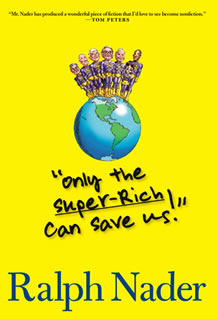
Only the super-rich can save us!
The world's pretty messed up right now. Everything's controlled by a few huge corporation who are to all intents and purposes above the law. Governments answer to the interests of big business. And big business answers to the interests of a few billionaires. The rest of us really don't matter a damn, and neither does the planet. Everything is sacrificed in the interests of profit.So what can we do about it? Realistically, probably not a damn thing. We can elect different politicians, and within months, they'll be completely in thrall to the same old corporations. We can launch consumer protests and boycotts, but they have such a hold on every aspect of our way of life that it'll only work if we all go back to being self-sufficient pioneers, and that just ain't gonna happen.
In this book, Ralph Nader plays with an interesting idea. What if a bunch of super-rich people got together and decided to change things? Using the skills they've learned for manipulating governments, media, and economies, and their vast personal fortunes, they effectively launch a commercial revolution. They champion alternative energies, they challenge Wal-Mart's stranglehold over retail, they tackle healthcare billing fraud and insurance companies, and they fight the way that corporations buy politicians. As a Brit, I missed some of the political and commercial references, but enough came through to keep me hooked throughout. I also learned a lot from his use of real legal cases and legislation.
Nader's protagonists are all real billionaires or multi-millionaires; Warren Buffett, George Soros, Ross Perot, Ted Turner, Bill Cosby, Bill Gates Sr, Paul Newman, and Yoko Ono, for example. By contrast, most of their "opponents" are fictional: CEO Cumbersome, Edward Edifice, and so on. This gives the book a strange feeling. It keeps reminding you that Nader's talking about the real world, not some imaginary thriller conspiracy world, but at the same time, it's only fiction.
Now obviously, this is a satirical fantasy, and it's wildly utopian. Somehow, I don't think these guys are going to pledge their personal fortunes to save the world. However, it's an enjoyable book, and an easy read even though it's nearly 800 pages long. Nader's analysis of what's wrong with American society is insightful, and needs to be read.
For me, the best part was when he showed how overturning the corporations was not just within the spirit of the Constitution, but was also completely compatible with capitalism. Nader argues that what we have in the US isn't actually capitalism, it's state capitalism. The big corporations are backed by the state and supported by the state. The laws are written for their benefit. They pay lower taxes than smaller businesses or individual. They get huge handouts. They control the courts and the media. They get preferential treatment in every way. That's not free market competition. That's not capitalism. That's basically an economy based on state-sponsored monopolies - a classic hallmark of communist regimes.
Although I don't get to vote in this country*, I'm trying to get to grips with American politics. I'm rapidly coming to the conclusion that the whole Republican/Democrat thing doesn't matter. They may chant different slogans, but in the end, they don't run the country. The corporations do. Whoever gets to Washington, it's the corporate lobbyists and their vast budgets who decide how Congress votes. They're happy as things are and can effectively block any changes that don't benefit them. And you don't get to vote for them. Worse, they have huge support because of their total control over big media. "What's good for business is good for America," they say. "If you damage our business, it'll cost jobs," they threaten. "We bring you cheap goods - what's the problem?" they ask. And so people nod and turn a blind eye to all the corruption, profiteering, and monopolistic abuse of power.
If you want to see real change in America, what's needed is to get rid of the unelected cartel that controls the government, and Nader makes this point eloquently, passionately, and with conviction.
"I hope we shall crush in its birth the aristocracy of our monied corporations which dare already to challenge our government to a trial by strength, and bid defiance to the laws of our country."
Thomas Jefferson
*I can't vote because I'm a resident alien, not a US citizen. I could opt to become a US citizen in a couple of years, but I haven't decided whether that's something I want to do.
Tuesday, October 21, 2008
A bit of rabble-rousing
As I mentioned in my review of Tom Watson's Causewired, I've been a bit of an online activist for some time, in my own quiet way. Here's what I did today in ten minutes over lunch.

It may not change anything, but at least I know that I've put my point of view to the people who are elected to represent me.
- Emailed my MEP about illegal logging
- Emailed my MP about the Climate Change Bill
- Emailed my MP about more support for renewable energy in the Energy Bill
- Voted in the EU Worst Lobbying Awards
It may not change anything, but at least I know that I've put my point of view to the people who are elected to represent me.
Subscribe to:
Posts (Atom)