Showing posts with label silent film. Show all posts

Wednesday, December 30, 2009

Woman in the Moon

The Netflix streaming service has once again done itself proud. Its growing collection of on-demand silent movies is becoming quite impressive. Today I watched one of the first "serious" science fiction movies, Fritz Lang's Woman in the Moon (also known variously as Frau im Mond, Woman in the Moon, Girl in the Moon and By Rocket to the Moon).

Released in 1929, it came shortly after Metropolis, and was quite remarkably ahead of its time. SF has been a staple part of film since Melies did his Voyage to the Moon in 1902, but it was mostly Verne-style fantasy. I was expecting something similar from this, with strange beasties or lost civilisations living on the Moon, much like the Soviet SF film Aelita, Queen of Mars, but it's nothing like that at all. If anything, it's more of a forerunner of 2001: A Space Odyssey and Apollo 13, crossed with a 1940s planetary exploration story.

The story's simple enough. A group of people take a rocket to the moon to prospect for gold, but their journey is marred by personal rivalries and jealousy, and once they land, it becomes a fight for survival.


However, what makes this film remarkable is the hardcore scientific setting, described by most critics as "prescient". The rocketship, which predates the pulp days of magazines like Astounding, is something both Werner von Braun and NASA would recognise instantly. It's absolutely not Flash Gordon. Much of the movie is taken up with the spectacular launch and flight to the Moon. His characters are worried about how to survive the g-forces during blast-off, and we see in detail how the acceleration couches are sprung to minimise the risk. It's a liquid-fueled multi-stage rocket, and we see the boosters drop away. Throughout the ship there are footstraps and bars so they can move in zero gravity, and yes, there are floating sequences, including a great bit where they're pouring drinks that turn into liquid bubbles they have to catch. We see them using retro-rockets to decelerate before landing, and we even get an explanation of the gravitational fields of the Earth and the Moon. The spacesuits are obviously diving suits, but they're more realistic than much of what followed in the hey-day of Hollywood SF. And when they land, we see them lighting matches to test for oxygen.

It's hard to remember that when this was made, it was 40 years before the first manned flight to the moon, and 25 years before even Sputnik. Lang worked closely with Hermann Oberth, one of the world experts on rocketry, and he drew his inspiration and design mostly from Oberth's influential textbook Die Rakete zu den Planetenräumen (By Rocket into Planetary Space) which was first published in 1929, a few months before Frau im Mond was released.

Of course, it's not all perfect science. For a start, there's breathable air on the Moon, so they can wander around happily. And while gravity's low, they're fine with heavy-duty diving boots to keep them anchored to the surface. The costumes are pretty cringe-worthy too: I couldn't help laughing at the men's outfits of everyday clothes (with a tie, of course) and a woolly cardigan.

However, that aside, this is a work of absolute genius, and deserves to be better known. In its day, it played a key role in firing popular enthusiasm for rocketry and space exploration. If it had been a sound film, it would probably have survived in the public consciousness much better. As it was, silent films were all but obsolete a couple of years later. Not until 1950's Destination Moon did we see a science fiction film that was so heavily based in real science.

It's available in a nicely restored print on DVD from Kino, and, as I said at the start, on Netflix streaming. If you love science fiction movies, do yourself a favour and watch it.

Monday, May 26, 2008

The next revolution will be televised

Whoever said that, back in the Sixties, was wrong. He was wrong by about half a century. It’s been going on for about as long as there has been film.

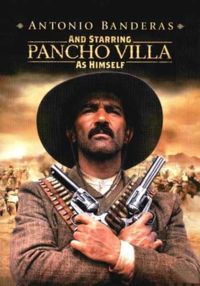
Starring Pancho Villa As Himself is a superb movie starring Antonio Banderas as the great Mexican revolutionary from the start of the last century. It’s based on an incredible true story, spanning the world of early movies, PR, media manipulation, and international politics.

In about 1912, Pancho Villa approached the great director D.W. Griffith’s Biograph Company, offering them the exclusive right to film his revolution in return for cash which he could use to buy guns. Griffith himself was busy with other productions (he shot a staggering 72 films in 1912!), so he sent a junior director, Frank Thayer. Thayer and his crew became the first war cameramen, getting right into the thick of the action and capturing real footage of battles. However, the film, Life of Villa, was a dud. Real footage of men fighting just wasn’t as exciting as the staged battle sequences that Griffith was making for films like Birth of a Nation. So in 1914, Mutual Film Corporation (who had bought Biograph the previous year) sent Thayer back to make a second film, The Life of General Villa, interspersing real-life battle sequences with staged back story, starring Pancho Villa as himself, and the young actor Raoul Walsh as Villa in his early days. (Walsh, of course, later achieved fame as a director, with over 130 films to his name.)

The Life of General Villa was, believe it or not, the first feature-length movie. Thayer convinced the studios and distributors that to tell the story would take an hour, and he simply couldn’t do his subject justice in two reels (24 minutes).

The motives behind making this movie were complex: it wasn’t just about trying to make a good film. Newspaper magnate William Randolph Hearst had business interests in Mexico, and had a vested interest in seeing Villa’s revolution fail. He was using his media empire to turn American public opinion against Villa. The fledgling motion picture wanted to prove that movies were more influential than newspapers, and decided to use Villa as a test case to see if they could sway opinion in the opposite direction. And the rivalry between Hearst and everyone else meant that there were a lot of people who quite liked the idea of seeing Hearst lose a lot of money.

The real Villa

So The Life of General Villa wasn’t just a film. It was a weapon in a new type of propaganda war. Movies won. This led, in turn, to Leni Riefenstahl’s propaganda movies for the Third Reich, live news reporting from Vietnam, and ultimately the embedded journalists in the Gulf who bring us our daily dose of gung-ho jingoism.

The most incredible sequence is where Villa agrees a contract with the movie company for the second film. He has to agree not to fight battles at night, because the cameras wouldn’t be able to film them. He has to give the film crew 24 hours notice of any engagements, and he agrees to restage any battle that they can’t film. And later, he has to replan an attack to suit the movie, because otherwise they’d be shooting into the sun. Literally, the war is being run at the convenience of the people filming it.

This is a fascinating film from a historical point of view, and a gripping film in its own right. Banderas delivers a top-notch performance, and the cinematography is stunning.

Sadly, all the original film of Villa is now lost, apart from a few clips in a museum in Mexico, but Starring Pancho Villa As Himself stands as a testament to one of the defining moments in the history of the motion picture business and its role in the modern world.