Showing posts with label film. Show all posts

Wednesday, April 13, 2011

Stuff'n'nonsense #4

I'm going to kick today's S&N off with a real blast from my past. I thought this had disappeared from the Internet for ever, but I should know better. Nothing vanishes from the Internet. This is a movie I made 11 years ago with Robert Llewellyn (Kryten from Red Dwarf). Okay, so that's the hype. The reality is that it was a short promo movie for a mobile phone game I designed at nGame. It was written and created by Charlie Dancey and Pavel Douglas (whose main claim to fame, in my eyes at least, is that he was in a Bond movie), and I had a small bit part, doing an off-screen voice. Music was by Manny Elias from Tears for Fears.

Anyway, without further ado, I present to you... Alien Fish Exchange: The Movie.


I'm actually really proud of that game. People loved it, even though it was a silly little WAP game which eventually made it onto interactive TV in several countries. In fact, one person loved it so much that he recreated the entire game, and you can go right ahead and download it. (Disclaimer:I haven't played it, so I have no idea whether it's at all faithful to the original or whether it'll turn your computer into a pile of steaming slime.)


Right, that's enough of the shameless self-promotion. On with the random bits and pieces.

  • Film news: it looks like there's finally going to be a film version of Anne McCaffrey's Dragonriders of Pern. I'm not sure how I feel about that, but mostly I'm thinking that's good, because I wanted to like the books, but found them totally unreadable. My dad loved them, and tried to get me to read them, but I just couldn't get through them.
    Mind you, he also had a complete collection of Gor books. I did read those. Several times. I preferred them to Anne McCaffrey.
    Errr, moving swiftly on...
  • Ah, Dita von Teese in a Wonderbra. Much better.
    Now click on through to watch the new Wonderbra TV advert for their strapless bras. It's a great advert. And, as one commenter said, if this really works on my DDs, then I want two in every colour they do. So, whether you're a lady or a gentleman, click on through and enjoy.
  • So you want to make a movie. How hard can it be? Check out this wonderful flowchart from Canal+. It's pretty much spot on, and very funny. And click around to find a bunch of similar ones from the same designer.
  • And more silly infographics (who the hell invented that word anyway?). How men and women perceive colour. Guilty as charged, m'lud.
  • Tonight's cooking has turned into something of an extravaganza. Singaporean fish curry for tonight, then I'm starting a tapas frenzy ready for lunch tomorrow. Chorizo & chickpea salad, red peppers with capers, chorizo in red wine, aubergine dip, mixed bean dip, and tuna, egg & potato salad. At least I won't have to cook for the next two days, apart from the bread. Well, that's the theory, anyway.
OK, that's it. Back to the kitchen. But let me leave you with a Gorean slave girl, in memory of my adolescence.

Monday, June 30, 2008

Conversations With Other Women

Conversations With Other Women is a quite remarkable film, for two reasons. Firstly, it has one of the sharpest and best scripts for ages, superbly acted, and utterly convincing. It's a character study of two people who meet up at a wedding, and, well, I really can't say any more without giving away the plot. The whole film basically consists of just these two people, played by Aaron Eckhart and Helena Bonham Carter, and it takes place in a single night. The emotional intensity they deliver is something you more normally associate with the stage, rather than the screen. However, they don't act like they're on stage; they make the events seem completely real.

The other thing that makes Conversations remarkable is that it's filmed in split screen throughout, one half focused on each of the two protagonists (mostly). It takes a little while to get used to, and I have to confess that after about 15 minutes I really wasn't sure whether I was going to sit through the rest of it. But I'm glad I did. Unlike Mike Figgis's Timecode, which is incredibly clever but unwatchable, this works really rather well. You just get used to having two viewpoints on the same scene, and effectively doing your own editing. Your eyes naturally flick between the two sides of the screen, depending on who you're interested in at any one moment. This is occasionally disorienting and disconcerting, but as a story-telling device, it's really rather effective.

Conversations is more than just a piece of technical trickery. In its way, it's as intriguing a piece of work as Memento, albeit with a focus on romance rather than action. It won't be to everyone's taste, but I'd strongly recommend that you see it and make your own mind up.

Sunday, April 6, 2008

Thirty's a crowd

I've been shooting a fight scene today set in a nightclub. As well as the two protagonists and a couple of bystanders who get involved, I needed a whole bunch of extras. There's a band, a couple of bouncers, and a load of clubbers, some sitting around, some drinking, and some dancing. For the first time, I found myself wishing I was shooting in an MMOG instead of using a script-based machinima tool. It would be so much easier to find 30 people, tell them what I want them to do, and let them run their dance animations. Instead, I'm having to script every one of those extras myself. Setting up the basic actions takes quite a lot of time, but then having to put all the reactions in and get all of them rushing for the door is really time-consuming, and really tedious.

One way of looking at it is that if I were to shoot the scene with lots of people, it would probably take three or four hours to get it right. That's 100+ man-hours. And if I later decide to reshoot, that would be a logistical nightmare, and I don't even want to think of the continuity problems. This way it'll take me a couple of solid days to get the scene, which is way fewer man-hours all told, and I know I can come back and tweak the lighting and the cameras later if I need to.

But that doesn't stop me wanting a tool for controlling crowds and some AI for my extras so I can get the whole scene done in half the time. Then maybe I can realistically aim for getting real crowds like this...

Hmmm... maybe I should hack Total War and change the soldiers into nightclubbers and turn their combat animations into dance animations... on second thoughts, maybe not! It's a damn shame the rumours a few years back of a freeware version of Massive never came to anything. It's rather too expensive for me.

Friday, April 4, 2008

The voice-over question

I’ve been messing round for a couple of months with a script for a noir-ish thriller, and I can’t decide how I want to tell the story. Oh, the plot’s there, and the characters are there, and I know what order I want the scenes in. I just can’t decide whether to go with a voice-over or not. And that changes my whole approach to how I write the script. Until I make that decision, I can't decide what has to go into the script, and what has to be carried purely visually.

I have to admit, I quite like voice-overs. I prefer Blade Runner with the voice-over, for example. Anyway, this got me thinking about voice-overs in general, and in particular why I’d want to use it in machinima.

The earliest use of voice-overs was mainly for narration and scene setting. Instead of audiences having to read text telling them what was going on, a narrator simply told them what was happening. This was all part of opening up movies to illiterate audiences, and made the whole movie experience less wordy. A great example, if only for its stiff upper lip British pomposity, is William Cameron Menzies’ Things To Come, where the narrator explains to the audience at each stage how the world got the way it did, at times interjecting with authorial moralization. When you look at that film now, the voice-over seems really clumsy, but the device has stayed in use in all sorts of formats.

Things to Come, based on the HG Wells novel

Think of the opening to Fellowship of the Ring, where we get a full introduction to Middle Earth through the narration of an epic battle. Or SF shows like Babylon Five (“the last, best hope for mankind”), Dune (“the spice must flow”), or even, though I hate to mention it, Star Trek (fill in your own quote, depending on which series you prefer). Voice-overs work particularly well for SF and fantasy, as there is usually a lot to explain to the audience, not very long to do it in, and relying on the script to carry all that back-story is hard to pull off.

Aah, an excuse to show a picture of Claudia Christian

In shows like Dragnet and Kolchak (a cheesy 70s precursor to The X Files), for example, the voice-over sets not only the scene but the tone of the show by mimicking police files. You know the style: “11:43 pm, July 25th, Los Angeles. Jenny Jacks is walking home, alone, unaware that she has been singled out by a serial killer. 11:52 pm, Officer Gerry Osgood arrives on the scene.” It’s really easy to parody that stuff, but writers continue to use it time and time again. It’s a really neat short-hand, almost like having Scully reading from her report – off-screen – at the end of each X File.

Sometimes the voice-over is used to supplement what’s on the screen, reading the exact same words for those who can’t be bothered to read them for themselves. In Dark Prince: The True Story of Dracula, there is a long opening explanation and historical introduction which, quite frankly, goes on far too long. If I’d had to read it all, I’d have been asleep before the movie actually started, which would be a shame, because it’s actually quite interesting and not your usual bloodsucker movie. Voicing it helped. And having the text as well meant that I didn’t lose track of what was going on due to being distracted by the visuals, unlike, say, Underworld Evolution, which still hasn’t made sense to me yet.

Dark Prince, a bio pic of Vlad Dracula. It's actually not bad

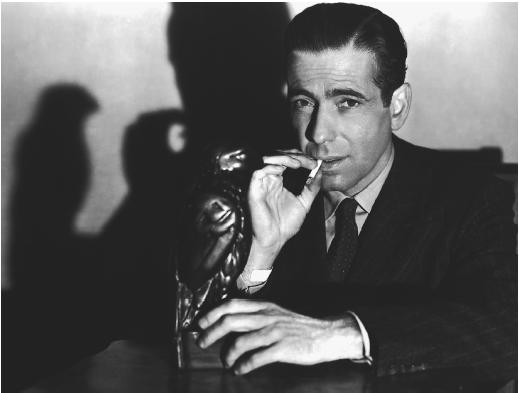
However, the main use of the voice-over, and what we mostly think of when we think of a voice-over, is to provide the first-person internal monologue that movies can’t provide any other way. It’s a staple of the film noir, which we always associate with Bogart and the like. The essence of Chandler and Hammett’s writing was to portray not just the story, but what it felt like to be a down-at-heel gumshoe. The books are full of commentary, effectively talking straight to the reader, and that’s not something you can do easily in movies. Ian Richardson did an amazing job of talking straight to camera in House of Cards, but that was the exception, rather than the rule.

Francis Urquhart: shows what a Shakespearean training can give you in the art of the aside

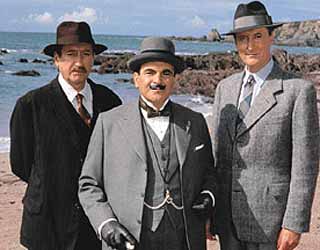
In general, you need to get the scriptwriter to put in a second character and put in the commentary in dialogue – hence the reason why so many movie adaptations give the hero a sidekick who wasn’t in the books. David Suchet’s Poirot, for example, uses Hugh Fraser as Captain Hastings and Philip Jackson as Inspector Japp far more than Agatha Christie ever did, purely to give Poirot someone to be in the reader’s place and allow him to explain himself without breaking the frame of the movie.

Not one but two dumb sidekicks

The only other option is the voice-over, which seems to be less and less popular these days. The voice-over really does shatter the illusion that you are watching reality. As the viewer, we are seeing this character do the things he does, but at the same time he’s talking to us, reminding us that what we’re watching is a story, an artificial construct.

Probably the best example of this is Kiss Kiss Bang Bang, a superb vehicle for Robert Downey Jr and Val Kilmer. Robert Downey’s totally irreverent narration turns this from a humdrum thriller into a wonderful cinematic experience. Director Shane Black plays with the conventions of filmic story-telling; fairly early on, he gets us into a flashback sequence by having Harry Lockhart go “woah, back up, there’s something I should have told you” (or words to that effect) and then apologizing for telling the story all wrong. It works really well – most of the time. Sadly, towards the end it gets more conventional, and not as much fun.

Kiss Kiss Bang Bang. Probably my favourite Robert Downey Jr movie.

I guess that’s the real kicker with voice-overs. Do them well, and they can work really well. But if you’re not careful, they can be lame, and a substitute for second-rate acting and directing. For example, I could have two characters have a conversation, and as one leaves, the other says in voice-over, “I knew I had to keep my eye on her. She was lying. I didn’t know what about, but I knew she was lying about something.” Very Phillip Marlowe. But instead, you could cut to a well-lit and well-framed CU, and convey all that with just a twitch of the eyebrow and a slight sneer.

Well, we had to have one picture of Bogey in this article, didn't we?

In machinima, though, you’ve got an excuse for going the voice-over route. Most of the time, you just don’t have the subtlety of performance you can get from a real actor or a hand-animated virtual actor. A "twitch of the eyebrow and slight sneer" in machinima can easily end up as a Groucho Marx eyebrow wiggle with a demented Joker-like rictus, which ain’t exactly the effect we’re after.

So where I find myself heading is that, if I were filming with real actors, I’d probably rely on them to carry the unspoken sub-text. But because I’m using machinima – and also consciously trying to get a bit of 1950s style into it – I’m going to give the voice-over a go. And if it turns out wrong, then hey, it’s machinima, I can afford to start again.

The machinima director

I've recently been reading some of the writings of the early Soviet film director and theorist Sergei Mikhailovich Eisenstein. It's amazing stuff, although seriously heavy going in places.

One thing that struck me was a note in Vladimir Nizhny's Lessons With Eisenstein. He reports Eisenstein's comment that:
"The director is simultaneously an architect, a poet, a painter, and a composer, but above all a film artist. No one aspiring to be a film director has any right to neglect anything that makes him a better man and a better film director."
Nizhny wryly says that this may seem excessive breadth of knowledge in these days where "a director is reduced to a craftsman giving orders for filming a ready-made scenario on already-built sets with the resulting footage being passed to the mercies of his editor."

As machinima directors, we're fortunate that we're still in the auteur position that Eisenstein held so dear. In my experience, machinima directors tend to be some of the most knowledgeable about the whole film-making process, because they have to be. We can - and usually do - have control over every aspect of our films. We often work alone, and we almost all make films purely for the love of it, to satisfy our own desires. We're not cogs in a giant production machine. We have more artistic and creative freedom than any other film-makers. We don't need to care whether our films are commercially successful. We get to be not just the director, but also the writer, the actor, the casting director, the production designer, the cinematographer, the composer, the set designer, the costume designer, the lighting designer, the sound designer, the editor, and ultimately we alone have final say as to when the film is finished. We are indeed "poets, architects, painters, and composers". We truly make our own films, from beginning to end. How many professional film-makers can say that?

Friday, March 7, 2008

Old wasn't old back then

I'm currently trying to make myself a set of Premiere filters that turn Moviestorm footage into something that actually looks like 1940s tinted monochrome stock. It's getting there. I've got one which is mostly green/gray tints (outdoor shots), and another which is magenta/navy tints (night shots and dark rooms), and I've nearly got the sepia/yellow tints right (normally lit rooms). But it's not right yet, and I think I finally figured out why.

This reminds me of something that always bugs me in sets for period movies. When they set something in an authentic location, the problem is that the buildings and so on look old, because they are. Weatherworn, stained, mossy, whatever. But of course it wouldn't have been old when it was new. In this pic, the steps should be pristine, with no staining on the parapet, the columns should look freshly sandblasted, and so on. OTOH, if you do make it all nice and new, it looks wrong because we're not used to seeing brand new old buildings, and we expect to see aging, so it looks like a set. You can't win.

It's the same with film stock. I've made something which looks more or less like it would have done back then when it was shot, but it looks wrong and fake, because we're used to seeing crappy reprints of 50-year old copies, and we expect to see loss of quality, even with modern digital restorations. So I'm trying to decide whether to artifically "age" the stock, which I don't want to do, or to find some other way of making it look less "fake". I don't want it to look "fake old" and add dust and scratches and all that jazz.

What I may well end up doing is play with the tinting a bit and try and come up with something hugely desaturated that has its own retro look, but isn't actually authentic - like the opening sequence of Sky Captain. I might have to go and watch that again now.

Saturday, February 2, 2008

Put some colour into it! (Or don't.)

Thoughts inspired by watching Good Night And Good Luck

This still looks fine, but they can't carry it through the rest of the movie.

I have no objection to black and white films. In fact, I'd guess that about a third of my movie collection is in black and white. But I do sometimes wonder why people make movies in black and white these days. It's not like the Forties and Fifties where black and white was a cheap option. More often than not, it comes across as pretentious rather than stylistic.

Spielberg got away with it in Schindler's List, but only because of that one famous image of the girl in the red dress. Putting everything else into monochrome made that single shot into an unforgettable (and much copied) piece of movie legend.

A single, unforgettable touch of colour.

But a movie like Good Night And Good Luck, the biopic of anti-McCarthyite crusader Vic Morrow, had no need to go monochrome. Obviously it was done to create the period feel, and to keep the archive footage homogenous, but this didn't really work. Instead, it just made the film look drab and cheap rather than historical. It looks as if it was shot using standard modern kit, and post-processed to have the colour removed. The result doesn't look like 1950's film stock, it looks like a modern digital effect, and that, for me, ruined it.

There were a number of other reasons I didn't like GN&GL (such as the slow story, confusing sound mix, and unengaging characters), but the decision to go black and white offended my cinematographic sensibilities. If you're going to make a colourless film these days, you need to replace colour with some other visual element. This means an excellent grasp of composition and lighting. You can't just shoot as normal and then take the colour out. It doesn't work that way. It's like colorising black and white movies - wrong, wrong, wrong!

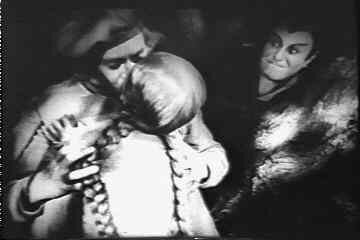
Paul Wegener's unique visual style in Der Golem (1915)

When you work without colour, you need to be thinking of every shot in terms of shape. Ignore what you see through the lens - you have to understand what the image will look like when bereft of colour and reduced to light and shadow.

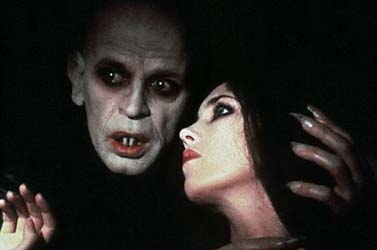
Murnau's Faust. Wonderful composition. The nearest you get to this in colour is Herzog's Nosferatu

Herzog uses heavy black backgrounds to emulate Murnau

The German Expressionists - Murnau and so on - were the real masters of this style, taking it to extremes. Sean Branney's excellent Call of Cthulhu, a homage to the silent horror movie, is one of the few recent films that makes this work. Or look at Jim Jarmusch's poetically beautiful Dead Man, where every shot is a memorable still photograph. And don't forget the hugely stylish Sin City, which transplants the unique look of Frank Miller's comic book to the screen, and really pushes for black and white, not greyscale.

As striking as Jack Sparrow, for my money

One key issue when filming black and white is that the differentiation between foreground and background has to be rethought. A red costume against a blue background may look fine, but if the tone is too similar, you get grey on grey and the character gets lost. To bring that differentiation back, you can use focus to blur the background out, but that's a real problem with some modern film kit, and especially with digital animation like machinima. You can also accentuate the difference with lighting, but that's also a problem for machinima which generally has very little lighting control.

The sort of lighting effect you only really get from black and white

For the machinimator or digital animator, the answer is to direct in black and white from the get-go. Don't take colour footage and post-process it, lose the colour right away. That's a luxury real film-makers don't always have.

I may try making some black and white machinima - one of the scripts I'm working on is inspired by Orson Welles' Mr Arkadin (aka Confidential Report), and I reckon that's the feel it needs. Now I need to persuade the Moviestorm dev team to make a black & white shader to go with the cel shader they've already done!

One of the very few Welles films I like, worth watching just for the grotesque characters

Tuesday, January 29, 2008

"I changed my life today, what did you do?"

The Verdict

A legal thriller that isn't based on a John Grisham novel - something of a rarity these days!

Sidney Lumet cut his directorial teeth on the tense courtroom thriller Twelve Angry Men in '57, before going on to gritty action flicks like Serpico in ‘73 and Dog Day Afternoon in ‘75. He returned to the legal genre in ‘82 with this highly acclaimed tale of medical incompetence and the fight for justice.

The Oscar-nominated script by David Mamet centres on the question of whether the parents of a girl who died in hospital should settle out of court without making a fuss, or whether to take the case to trial and force the doctors to admit that they were negligent. The drama, of course, is that the judicial system is so heavily on the side of the medical establishment (and, in this case, the Church who runs the hospital) that it doesn’t look as though there will be a fair trial. Should they cave in and take the money, or stand up for justice?

Paul Newman, pushing sixty when he made this, delivers a powerful performance as Frank Galvin, the cynical, hard-drinking, world-weary lawyer who finds he has a real case for the first time in years. (The quote at the start is, of course, from him.) A cliche of a character, sure, but well done. Think of Tom Cruise in The Firm crossed with Sam Spade and you’re about there. Newman lost out on the Best Actor Oscar to Ben Kingsley in Gandhi, which is, admittedly, hard to argue with.

James Mason plays the opposing lawyer, which he does in his usual suave manner. I like Mason, I like him a lot, but on this occasion he doesn't seem to quite come up with the goods. His performance is polished enough, but he portrays the character in such a fair and reasonable light that the result is bland rather than dramatically ruthless. A little more melodrama wouldn't have gone amiss. Mason got an Oscar nom as well, though it’s hard to understand why, until you look at the competition that year. For me, the real villain of the piece is Milo O'Shea as the judge who's obviously biased in favour of the defence.

Charlotte Rampling is at her most icily gorgeous as Laura Fischer, Newman's supportive lover who's playing both sides. (This was the last film she made before getting hitched to Jean-Michel Jarre.) Oddly, though, I kept on wanting Sigourney Weaver in the role; Rampling comes across as a bit of a scheming, unfeeling bitch, rather than the tough, powerful woman Weaver would have been. I wasn't really interested in the sub-plot with her, though. It was never really as developed as it might have been, and I couldn't really work up any interest in her character.

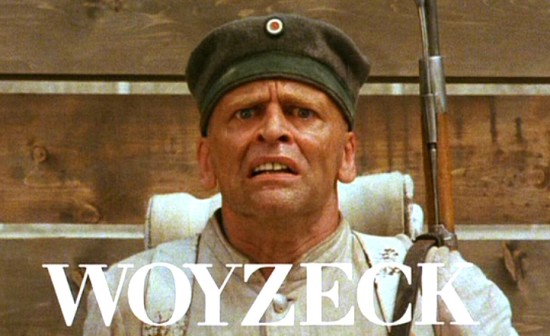
Where The Verdict really wins for me is the very elegant style. The camerawork is well worth a close look. It's not flashy or complex, but it's a very good example of how to use simple shots very effectively and economically. Some scenes are shot entirely with a single static camera in long shot, which works surprisingly well. Normally this technique only turns up in very early films or in arty movies like Werner Herzog's unremittingly bleak Woyzeck, but Lumet makes it work. The simplicity of the camerawork, combined with almost total absence of music, gives the film a very real feel that is quite different from the cinema verite style the directors of the Seventies were trying to ape.

The very few 'tricksy' shots are nicely constructed; there's one sequence where we look through a window at Newman and Jack Warden coming down the stairs inside the courthouse, and then the camera pans gently to pick them up as they come out through the door. This is very distinct from the more 'in your face' style of filming that Lumet picked up from movies like The French Connection, and it makes for easy viewing, allowing you to concentrate 100% on the story. Aspiring cameramen, editors and directors would do well to see how much you can achieve without ever drawing attention to the camerawork, moving the camera only when necessary, and cutting smoothly and efficiently to keep the viewer engaged.

Gene Hackman in The French Connection

On the whole, I preferred this to Lumet's earlier action films, and I'd undoubtedly rate it as one of Newman's best roles. In my view The Verdict isn't a great film, despite also getting Oscar noms for Best Picture and Best Director (did you count ‘em? That’s five noms, no wins, thanks to Gandhi) but it's very definitely a good, solid, well-made drama with an easy-going style that's well worth a couple of hours.

Friday, January 11, 2008

What to do with a movie library?

One of my great joys, while growing up, was visiting my aunt and uncle in the holidays. Ted was a serious film buff (among other things), and the room where I used to stay was packed from floor to ceiling with books and magazines about movies, which I used to read voraciously. In fact, it would be fair to say that Ted's collection of movie books was largely responsible for me doing what I do today.

From as early as I can remember, I used to plough through magazines like Famous Monsters of Filmland, and I knew my way through the canon of German Expressionist films before I'd seen any of them. I could tell you all about the making of Gone With The Wind or Wizard of Oz, I knew what the concept art for Fantasia and King Kong looked like, and names like von Stroheim, Eisenstein, Griffith, Pickford, Chaney, Fellini and Bergman tripped off my tongue with the fluency of a seasoned student of film. I used to read the screenplays and shooting scripts of all my favourite RKO horror films, and knew by heart the production notes of the masterworks of Welles, Hitchcock and de Mille.

This library was an absolute treasure trove of information. It was far larger and more expansive than anything my local library could offer me, and the best I was likely to see outside a film school. (In fact, I didn't seen anything to rival it until I visited the American Film Institute last year and saw what was on their shelves.)

Ted died just before Christmas, and left me his library, but sadly, I find myself wondering what to do with it. Aside from the practical issue of where to put a thousand or more books, I begin to wonder how many of those books I would ever look at now. The Web offers so much information that this enormous stack of books is no longer a collection of information you can't get anywhere else. And, what's more, the Web's easier to use. DVD extras also provide so much background material, in a more friendly form, that I'm less inclined to read a book about the making of a film than I used to be.

There's a side of me that would love to own such a library, but on the other hand, it doesn't seem nearly as useful or as interesting as it did ten or twenty years ago. Maybe it's one of those side-effects of progress, and books are, regrettably, becoming as obsolete as vinyl LPs, reel-to-reel tapes or slides.