Friday, November 20, 2009

Matt's Guide to 2012


2012 isn't nearly as unremittingly bad as some people make out, as long as you approach it in the right way. Here's my handy five-step guide.
  1. Make sure you have a few beers beforehand. Three or four should suffice. You don't want to get too drunk at this stage.
  2. Spend the first 30 minutes of the movie in the bar with some more beer.
  3. Spend the next 30 minutes of the movie in the bar with yet more beer. (Don't worry, you're not missing anything. Some dudes figure out the world's about to blow up.)
  4. Go into the movie and watch the world blow up for about an hour. Take beer in if it's that kind of cinema. Watch LA fall into the sea. Watch Hawaii burn. Enjoy!
  5. As soon as you see the flying elephant, LEAVE THE AUDITORIUM. (You'll know what I mean when you see it.) Do not stop to collect personal belongings. Do not pass Go. Do not collect $200. Return to the bar and drink beer while laughing at the complete absurdity of what you just saw.
A final word of advice. Do not try this at home.


Friday, November 13, 2009

So close...

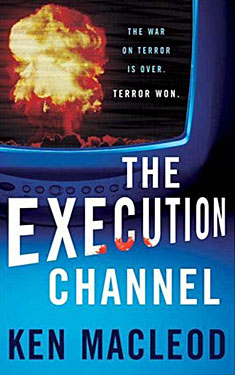
I had the strange experience today of giving up on a book 20 pages from the end. It was a harmless enough book, The Execution Channel, a thriller about a series of terrorist attacks in Britain - or are they in fact the start of World War Three? It's billed as science fiction, but it's not really what I generally think of as SF. It's in a slightly alternate universe (Gore won), but otherwise it's just technically literate: these people communicate via blogs, understand the net, and so on. Anyway, that's not the point.

I read some of it last night, and then carried on this morning. About an hour before starting work, I got up to make coffee, and by the time I got back to bed, I realised I didn't actually care about what happened in the end, and couldn't be bothered to read the last 20 pages. That's a really odd feeling. I mean, having got that close to the end, why not finish? Or if I really wasn't enjoying it, why didn't I give up earlier and read one of the other dozen library books by the side of the bed?

I'm actually very intrigued by what it is that makes us decide to give up. How long do we persist with a book or a movie before we decide it's not worth going on? What is the trigger point that causes us to make that decision? If you quit too early, you miss out on all those experiences where the start's a bit slow or a bit lame, but once you get into the characters or the story, it's a thoroughly enjoyable experience. And what about those acquired tastes - movies or pieces of music that you don't much like at first, but gradually grow on you - how many times are you prepared to sit through something you don't like in the hope that it'll start to become enjoyable? (Like Shostakovich string quartets or 1950s French movies.)

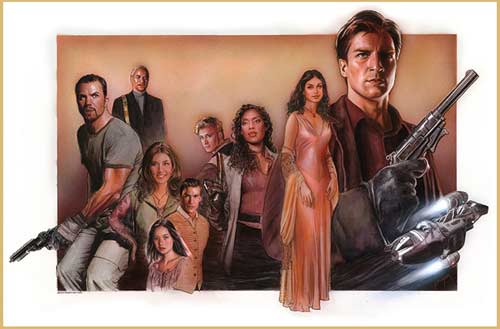
This is hugely important for what's happening with TV. Many shows take a while to get into. The first few episodes of a new show are often slow, while you're getting into the characters. Firefly and Dollhouse were both good examples. So you watch 4 or 5 eps, it's looking OK but nothing great - do you continue? You've just spent 4 hours on this show, and you're not really enjoying it. That's a big investment of time, and logic says give up. So you give up. Viewing figures drop, and the network immediately respond by canceling the show. Meanwhile, the hardcore continue, and then the word of mouth starts to go out that it's worth persevering, because by ep 7 it gets brilliant, but it's too late, and you kick yourself for not sticking with it, and everyone screams at the dumb network for canning such a superb show. Well, that's scenario 1. Scenario 2 is where it doesn't get any better, and you mentally file it under Shit I've watched on TV when bored out of my skull.


TV networks are desperately chasing ad money, and that means having to respond very fast to audience figures. If people stop watching a show, they'll can it within weeks. With so much available at the click of a mouse these days, you only have to lose your audience for a few moments and they're gone elsewhere. That's a harsh world to be in. So, for a writer, or anyone else creating entertainment, it's critical to understand what it is that makes us decide not to watch the next episode, or not to turn the next page. I don't think anyone's figured that out yet, except perhaps the teams behind X Factor and the like. Part of their secret is that they're working live, so they can judge the audience on a day by day basis, and adjust their show to fit the audience's mood. Mind you, the audience eventually turned on Big Brother, so reality TV doesn't have all the answers. I sure as hell don't.

Oh, and by the way, it wasn't a bad book. I'm sure if I hadn't got up for that coffee, I'd have finished it quite happily. It was more like that feeling of getting up to answer the phone near the end of a meal, and when you get back to the table, you just can't be arsed with the last couple of mouthfuls.

Monday, November 2, 2009

What makes good TV?

Over on Facebook, I've been making a load of comments about various TV shows, usually none too complimentary. It's not that I've been rude, it's more that much of what I've been watching hasn't really lit my fire, even when it comes to really popular shows like House or West Wing. Some readers seem to think that I'm simply not taking to American TV, but it's not that at all: I barely watched TV in the UK either for the last couple of years, so I've been catching up on various series on DVD to see what I've been missing, and mostly finding myself disappointed.

I don't like reality TV, I can't stand makeover shows, and I find most talk shows vapid. I really don't like comedy that's too close to my working life, so shows like The Office and the IT Crowd drive me crazy. I don't enjoy police procedurals, particularly not of the CSI vein, and I don't like medical dramas. I don't like gritty depressing reality, I avoid soaps like the plague, and I get bored by "monster of the week" supernaturals.

It's not that they're bad TV. Some shows of these types are really good, and I'm not for a moment denigrating them as a whole. But I've watched way too much TV, and now I'm bored by most of it, just as I'd finding it increasingly hard to find books I like or films that hold me riveted to the screen.

Anyway, one person eventually asked me the obvious question. What do I like?

Ummm.

That's actually a tricky one.


The only broadcast TV shows I've watched in the last year were Top Gear, Mock the Week and QI, and that surprises even me, as they're not really the sort of thing I normally watch.

I like to watch stories: drama, adventure, action, mystery, and intrigue. I like exotic or historical settings, larger than life flamboyant characters, and plots that stretch the imagination and the credulity. I like either a good long story told as a serial, or I like simple, snappy, self-contained episodes that you can pick up piecemeal, rather than "arc" programming where you sort of need to see the individual episodes in order or you can get mixed up. I like touches of humour in serious drama, and I like to be awed and amazed occasionally by both the breadth of the writer's vision and the visual richness. But most importantly, I like not being able to write the next line of the script or being able to predict the plot twists. I like to be surprised.


My tastes aren't defined by any particular genre. I like science fiction, for example: Firefly was superb, Dollhouse was really good, the first three seasons of Babylon 5 were brilliant, I loved the first two seasons of Battlestar, and the recent Sci-Fi channel Dune mini-series were outstanding. On the other hand, Star Trek doesn't do it for me, Farscape was so-so, and I think I grew out of Doctor Who when I was about 15. I can't just say "I like sci-fi". I'm picky. Very, very picky. (Or "selective", as I'd prefer to call it.)

Similarly, Deadwood was one of the most enjoyable series I can remember, but that doesn't mean I want to watch more Westerns. In historical programming, Rome was utterly compelling, (and so utterly different from I Clavdivs), I've watched every episode of Sharpe repeatedly, North and South was good, if dated, but Charles II was dull, and Blackbeard was utterly dreadful. (He was from Bristol, for crying out loud, what on earth possessed them to make him a Scot?) It doesn't have to be serious, either: Middlemen is wonderful cheesy fun, and Warehouse 13 is good, tongue in cheek adventure.

In a nutshell, I never know what I'm going to like, and I often find the shows I like best weren't the shows I expected to like.


I know as well as anyone that there's no such thing as a truly original story: all stories are reworkings of existing material, and there are certain conventions that we expect story-tellers to follow if they're going to produce a "satisfying" story. However, there is still scope for originality. I love genre-crossing - that's why I enjoyed Firefly so much, with its "cowboys in space" riff. I like genuinely unusual characters, not the usual "tired/rebellious/maverick cop with an incongruous taste for jazz/opera/blues", or the formulaic "buddy duo forced to work together who then become friends" (and if they're opposite sex, several seasons of will they, won't they). I'm really looking forward to No 1 Ladies Detective Agency, I wish I'd seen more of The Secret Adventures of Jules Verne, and I'm thoroughly enjoying watching Young Indiana Jones.

So, in short, my formula for TV success is this:
  • Take me to a setting that takes me away from my everyday life;
  • Show me characters that aren't cliched, even if they're stereotyped;
  • Make me laugh, make me gasp, and surprise me, all in one episode;
  • Give me sharp, tight writing, and;
  • Either stay faithful to the source if that's what you're doing, or bring together elements that haven't been combined before.
Of course, that's no guarantee of commercial success. If it had been up to me, I'd have turned down most of the successful TV shows of the last 15 years. I'm aware that what I like isn't what you'd call mainstream entertainment.

But that's the beauty of the Net, and it's where machinima and other low-budget or zero-budget techniques really win. No TV company, especially in today's economic climate, can afford to take a chance, but amateurs can. I'm finding more and more that my entertainment needs are supplied by Web series and amateur movies such as The Mercury Men, and their production values are getting better and better.


Tuesday, October 6, 2009

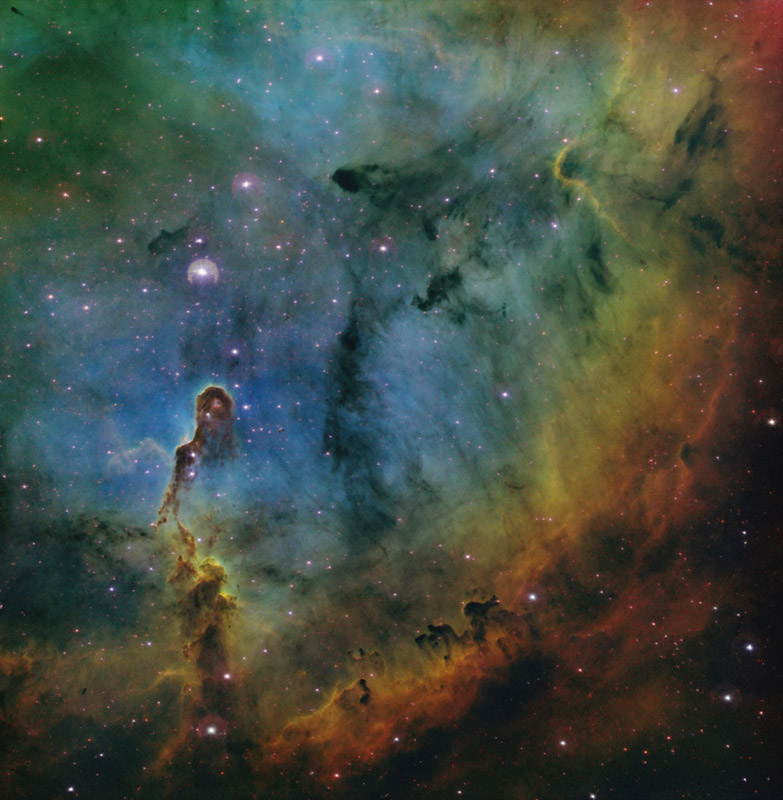
Elephant's Trunk Nebula

Image (c) Paul Beskeen Astrophotography, 2009.

Wow. This is not a painting. This is the real thing, shot by my friend Paul, using the telescope in his back garden.

Saturday, September 12, 2009

Leapin' Lizards!

One of the things I like about this place is that there are lizards everywhere. And, to my surprise, they jump!

Sunday, September 6, 2009

A nice cuppa

I'm slowly getting used to the fact that when I ask for tea in Florida, I'm not going to get one of these.

Nope, what you get is something completely different. For a start, it's cold. If you want hot tea, you need to specify hot tea. Then the chances are they'll bring you something made with green tea. You see, you should have said black tea if that's what you wanted. Then they helpfully go and put cream in it instead of milk. And then, if you wanted it sweetened, they pour honey in it. There's not much else they could do different. It is, in the words of the late, great, and much lamented Douglas Adams (who was, like me, an alumnus of St John's College, Cambridge) "almost, but not quite, entirely unlike tea."

It's easier just to accept that this is tea, and the good old English cuppa is something to be enjoyed in the comfort of my own home.

Saturday, September 5, 2009

Little things

I've been in Florida for just over a month now, and while it's easy to focus on the big differences (huge thunderstorms, palm trees everywhere, people talking in strange accents, and everything being so much bigger), it's often the small things that make all the difference.

Take light switches, for example. They're all upside down. Down is off, and up is on. Well, the ones on the walls, anyway. The ones on lamps are strange twisty things instead of clicky pushy ones, which requires way more digital dexterity than I can manage last thing at night.

Now, coffee. We all know Americans are coffee experts. So, you want a cup of coffee. You boil the kettle, then you... uh, hold up there. The kettle? They don't have kettles here. If you want hot water, you boil up a pan of the stuff on the stove. If you're really classy, you can get an old-style kettle for the stove, like my great-grandmother used to have. You can go to Wal-Mart and choose from one hundred and sixty-three different models of coffee machine, but they offer precisely one type of electric kettle. They have machines for just about everything else in the kitchen, but not for making hot water. Weird.

This, my dear American friends, is a kettle...

... this is a piece of antiquated steam-age technology.

If you really want to confuse them, use a 24-hour clock. You'd have thought, given how militarized this place is, that they'd all understand what time 1645 is. But no. Seventeen hundred hours, sure, you can probably get away with that. But most of the time you're best off sticking with 12-hour clocks.

And then there's driving. Most of my driving in the US has been in California, and it's not quite the same here. As Maus pointed out, in Florida, they drive on both sides of the road. However, I haven't been brave enough to try that yet, and I'm sticking to the right for the time being.

Let's start with speed limits. As my instructor pointed out to me regularly, the speed limit means the maximum you can drive at. It doesn't mean you have to do that speed. And ever since I got pulled over for doing 32mph in a 30mph zone, I've always been seriously careful to stay below the speed limit. not on it. Here, though, it basically means that's the required speed. And since you don't get prosecuted until you're 5mph over the limit, the required speed is actually somewhere between 3.5mph and 4.5 mph over what it says on the sign. Drive at the speed limit, and you're likely to find yourself hauled over for driving suspiciously, holding up traffic, un-American activities, and anything else they can think of. 5mph over, and you're a dangerous lunatic who deserves to be run off the road. Since the speed limit changes every couple of hundred yards, the age of the computer-controlled car with sensors that know the current speed limit and adjust your speed accordingly cannot come fast enough.

No this isn't a local sign, but I loved the pic.

I was also fairly rapidly introduced to the concept of the "California stop". They have these STOP signs all over the place, which I've always understood to mean that you slow right down, pause, and then take your turn before proceeding. Not so in Winter Park, apparently. That's a California stop, and it's Bad. Very, Very, Bad. Here, STOP means STOP. Come to a complete halt, recite the Lord's Prayer under your breath, and then move off. Failure to stop at a stop sign is a monumental vehicular crime, the magnitude of which can only be compared to mowing down a crowd of school kids and war veterans in the midst of pledging allegiance to the flag during a Sunday church service on a site of national historical significance, and then smashing into a state memorial. Or hijacking the mayor's personal golf cart. Roll through a stop sign and it's Stop, Do Not Pass Go, Go Straight To Jail, Do Not Collect $200. Well, pay $200, or $400 if they feel like it. But you get the idea. And why do they have such odd amounts for parking fines? At the Winter Park Village, if you park in a handicapped space, the fine is $212, except in the space nearest the door of the shop, where it's $213. That makes sense. Don't park in that space, honey, it's an extra dollar if they catch you. Riiiiight.

Speaking of golf carts, though, the Winter Park police ride around in them. This is a country club city, so they fit in well. And in Orlando itself, they have bicycles. That's cool too. Up the road in Seminole Country, whoo-boy, that's a whole different story. The Sheriff's Department got a load of money from Jeb Bush a few years back, and they spent it on buying tanks. Yup, I said cops in tanks. Run a red light in Seminole, and you can have a 76mm shell up your tail-pipe and 5000 rounds of machine gun ammunition in your gas tank in under 3 seconds. (Actually, that might count as quite a big difference between here and England.)

And why, for God's sake, why is all the money the same size? It makes life so easy to sort your cash out when the notes are different sizes. I keep thinking I've got down to a small stack of dollar bills, and then I find a twenty in there. Or else I'm rifling through, hunting for the fifty I've lost in the middle of them.

Mind you, some things are considerably more complicated than they at first appear. I've just about got my head around the fact that courgettes are zucchini and aubergines are eggplants. Except, apparently, in posh restaurants where they're courgettes and aubergines. I guess it's like fancy restaurants in England where they give things French names, so you feel stupid if you don't know the foreign words. "Would Monsieur care for some pommes frites with his poulet avec fromage?" Uh, yeah, cheesy chicken & chips will do fine, thanks. Fries. Whatever. Oh, and there's a Science Center and an Arts Centre. See, it's classier in English. But they still don't understand if you ask them to hold the tom-AH-to. It's tom-AY-toes or nowt.

Still, I seem to be surviving well enough.

Seriously, though, you know what's really different? Not having goddamn CCTV cameras everywhere you go, on every street corner, every road sign, every shop, and every public building, recording your every move and keeping tracks on everywhere you go. Now that, I like. A lot.